
Amsterdam, Netherlands
Tante Leen was born Helena Kok-Polder in 1912 in Amsterdam. At the age of 43, while working at a café cleaning and peeling shrimp, her coworkers signed her up for the Jordaan talent competition.
Though she finished second to Johnny Jordaan, the pseudonym for Johannes Hendricus van Musscher, she became a renowned Dutch folk singer, frequently pairing up with Jordaan and backed by accordion wizard Jan Schallig.
Her nostalgic, working-class anthems earned her great fame, particularly the playful response song “Oh, Johnny” aimed at her friendly rival Jordaan. By 1960,
Tante Leen was such a beloved icon that she opened her café, where adoring crowds came every evening to hear her soulful voice live on stage. Though honored with an invitation to represent the Netherlands at the 1968 Eurovision Contest, Tante Leen preferred keeping to her local community roots. She finally retired in 1975, leaving behind a treasured legacy as a star who found her voice and touched the souls of everyday Dutch people with her heartfelt lyrics. Leen passed away in 1992.
Two years after Johnny Jordaan passed away, in 1991, the Johnny Jordaanplein, also known as Johnny Jordaan Square, and his bust were dedicated in his honor. After a few years, statues of Tante Leen, Johnny Meyer, Manke Nelis, and Jan & Mien were added. All were sculpted by the Dutch artist Kees Verkade.
Tante Leen statue is one of the few statues of women in Amsterdam and the only one that honors a female musician. Read more...

Utrecht, Netherlands
Behind the Janskerkhof Bloemenmarkt flower market stands a bronze statue of Anne Frank, commemorating the Holocaust victims, the victims of discrimination and persecution in Utrecht, and more than 1,200 Jews from Utrecht who were murdered.
On Liberation Day, May 5th, 1959, the year Anne would have celebrated her 30th birthday, the youth of Utrecht gave this statue to the city as an appreciation gift for the various youth associations the Utrecht has organized. They collected scrap iron and paper to finance it, and the Utrecht sculptor Pieter d’Hont created it, depicting Frank standing, looking forward, and strong. It is the first statue of Anne Frank in the world, unveiled in 1960.
Traditionally, flowers are placed at the statue all year round, and every year, during the commemoration of the dead, there is a gathering next to it.
Anne Frank (1929-1945) was a German-Jewish teenage girl when World War II embarked. When the Nazis invaded the Netherlands and enforced antisemitic rules that demonized, isolated, and threatened their lives, on July 6th, 1942, the family hid in a secret annex in her father’s office building in Amsterdam.
During her time in hiding, Anne wrote in the diary she received for her 13th birthday, expressing her thoughts and feelings about the war and the day after.
On August 4th, 1944, the secret German police discovered them, deporting all the annex residents to a concentration camp, where Anne, her sister, and her mother died.
After the war ended, Anne’s father returned to Amsterdam, discovering he was the only survivor. He found Anne’s diary and published it, fulfilling Anne’s dream of becoming a writer and sharing her testimony about her childhood during World War II.
Over the years, The Diary of Anne Frank was translated into more than 70 languages and sold over 30 million copies worldwide, making Anne one of, if not the most known, Holocaust victims.
The Dutch Canadian Club Edmonton unveiled a copy of this statue in Edmonton, Canada, in August 2021.
Click here to see more statues of Anne Frank around the world. Read more...
The Hague, Netherlands, Europe
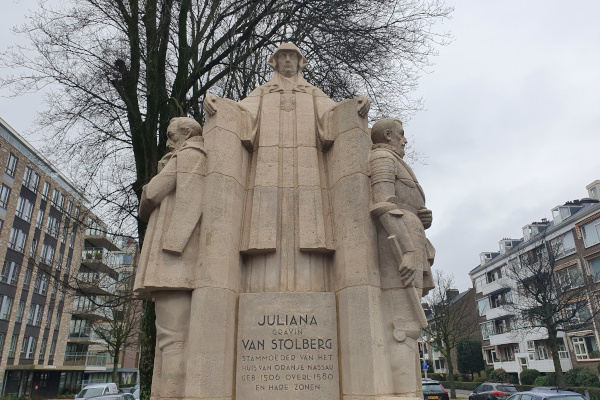
Juliana van Stolberg (1506-1580) was born and lived most of her life in Germany. At 14, she married Count Philip of Hanau-Munzenberg, and together they had five children. In 1529, Philip passed away, and she married Willem de Rijke. Together they had twelve children; seven daughters and five sons. Her son, William of Orange, led the successful Dutch rebellion against Spain for independence. His brothers also fought the battle, and some even died during the war.
Three hundred years after Juliana van Stolberg passed away, old letters revealed that she was not only the mother of five of the commanders of the Dutch rebellion but that she had a significant role as a consultant and financial supporter.
Inspired by her actions, Queen Wilhelmina named her first daughter and heir to the throne, Princess Juliana, in her honor.
On April 30th, 1927, on her 18th birthday, Princess Juliana laid the monument’s cornerstone; three years later, she unveiled it in the presence of Queen Wilhelmina and Queen Mother Emma on the Louise de Colignyplein in The Hague.
The sculptor Bon Ingen-Housz and the architect Dirk Roosenburg created it. They depicted Juliana van Stolberg in a tall stone heptagonal sculpture standing alongside her five sons – William I of Orange (Willem van Oranje), John VI “the Elder” (Jan van Nassau-Dillenburg), Louis of Nassau (Lodewijk van Nassau), Adolf (Adolf van Nassau), and Henry (Hendrik van Nassau).
Inscribed below Juliana is the following text:
“Juliana
Countess
van Stolberg
ancestress of the
House of Orange Nassau
b. 1506 deceased. 1580
and her sons”
On March 3rd, 1945, the British air force bombed the area causing the death of 500 people. The statue was barely scratched; in 1954, when the Bezuidenhout got rebuilt, the monument moved to the corner of Koningin Marielaan and Juliana van Stolberglaan, serving as a memorial to the 500 victims of the bombardment of Bezuidenhout.
A 10-minute walk will get you to the beautiful and spacious Haagse Bos park. Read more...

The Hague, Netherlands, Europe
In the center of the square on the avenue that bears her name, a bronze statue of the Queen of the Netherlands, Anna Pavlovna of Russia, is sitting on a bench, looking at and mingling with the visitors of the square while holding a decorated hand fan. The Russian sculptor Alexander Taratynov created it in 1999.
Anna Pavlovna of Russia (1795-1865) was born to the title Her Imperial Highness Grand Duchess Anna Pavlovna of Russia in the royal family of Russia. In 1816, Pavlovna married the Prince of Orange, who became King William II of the Netherlands in 1840. Together they had five children.
She had difficulty accepting the cultural differences between her home country and the Netherlands, specifically with the lack of distance between the royals and the commoners. As a princess and later as queen, Pavlovna learned the Dutch language, history, and culture; she focused on charity work, financing many orphanages and schools and establishing charity organizations.
In 1849, after the unexpected death of her husband, she retired from royal life and lived privately and a bit alone until she died in 1865.
Around the square are some lovely local restaurants. Panorama Mesdag museum and Noordeinde Palace are within walking distance to the east. Heading north from the statue will lead to the De Mesdag Collectie art museum and the Peace Palace. Read more...

Amsterdam, Netherlands
This memorial commemorates the women and men who died because of their sexual orientation and celebrates gay emancipation.
The pink Rosa Porinogranite monument is in the shape of three equilateral pink triangles representing the past, present, and future, forming one large triangle together. The pink triangle shape symbolizes the small pink triangle mark, which homosexuals had to wear in the Nazi concentration camps (Jews wore a yellow Star of David). Since the 1970s, the symbol has become a proud symbol against the oppression and exclusion of gays, lesbians, bisexuals, and transgender people.
The plaque reads:
“Homomonument Commemorates all women and men ever oppressed and persecuted because of their homosexuality.
Supports the International Lesbian and Gay Movement in their struggle against contempt, discrimination, and oppression. Demonstrates that we are not alone. Calls for permanent vigilance.
Past, present, and future are represented by the 3 triangles on this square. Designed by Karin Daan, 1987.”
Located in the heart of Amsterdam, the memorial serves as a gathering place for various purposes, including protests, demonstrations, couples celebrating their love, and mourners. Annual large commemorative gatherings take place on National Remembrance Day (May 4th) and Transgender Day of Remembrance (November 20th); large parties take place on Liberation Day (May 5th), the King’s Birthday (April 30th), and the Amsterdam GayPride (first weekend of August).
The idea to commemorate WW2 gay victims started in 1961 by the activist Jef Last who suggested a monument to the unknown gay; however, the project never materialized.
Throughout the 1970s, gay activists laid wreaths at the National Monument to the Victims of World War II on Dam Square, Amsterdam, bringing to the public awareness the victims of Hitler’s “social purification” campaigns. Sometimes the police removed them.
To erect an enduring monument to persecuted homosexuals, the Homomonument Foundation was founded in 1979.
In 1980, among 137 designs, they chose the design of the Dutch environmental artist Karin Dan. After overcoming several bureaucratic difficulties, the monument was finally dedicated on September 5th, 1987, becoming the first monument in the world to commemorate gays and lesbians the Nazis killed.
This memorial inspired the installation of a similar monument in Barcelona, Spain, in 2011. Read more...

Amsterdam, Netherlands
The Anne Frank House is a biographical museum commemorating the teenage holocaust victim and her family.
Anne Frank (1929-1945) was born in Frankfurt, Germany, to Otto and Edith Frank. In 1933, following Hitler’s rise to power, the family moved to Amsterdam, the Netherlands. There, her father established a fruit extract company located at a 17th-century building on Prinsengracht 263. She had a normal childhood; she went to school, loved to read, and enjoyed riding her bike.
That changed in May 1940, when Nazi Germany invaded the Netherlands and enforced antisemitic rules that limited the freedom of the Jewish citizens and threatened their lives. The Frank family tried to escape the country but were eventually trapped under the Nazi regime and decided to go into hiding.
On July 6th, 1942, the family moved to a secret annex at Otto’s office. It was a 450 square feet space at the rear extension of the building, hidden from all sides. Within a few months, four more people came to live in the annex – a dentist named Fritz Pfeffer and the Van Pels family – Hermann, Auguste, and their son Peter.
For the next two years, Anne described her life in the diary she received for her 13th birthday, only a month before moving into the annex. In it, she expressed her thoughts and feelings about the war and the day after; she detailed her daily routines, her conflicts with her mother and sister Margot, her opinions of the other annex’s residences, and her feelings toward Peter Van Pels.
When she heard on the radio that the government would collect and publish diaries written during the war, Anne, who aspired to become a famous writer, decided to edit her diary into a running story – The Secret Annex.
On August 4th, 1944, the secret German police raided the annex and deported all its inhabitants to Auschwitz. Later on, Anne and Margot were sent to the Bergen-Belsen concentration camp, where both died of typhus, Anne at 15 and Margot at 18.
After their evacuation, Miep Gies and Bep Voskuijl, two of Otto’s employees who helped hide the families, managed to rescue some of the residences’ belongings; Anne’s diary was among them. Otto, the only surviving family member, returned to Amsterdam after the war and received the diary. He decided to fulfill his daughter’s wish, and in 1947 it was published in Dutch.
The book was titled Het Achterhuis. Dagbrieven van 14 juni 1942 tot 1 augustus 1944 (The Secret Annex. Diary Letters from 14 June 1942 to 1 August 1944) as Anne wanted. It became a bestseller, drawing people to visit the building and view the hiding place. It was later retitled the Diary of Anne Frank and translated into more than 70 languages.
In 1955, demolition was planned for the building. Following a successful campaign by a Dutch newspaper, it was saved. Two years later, Otto established the Anne Frank Foundation to purchase the building and turn it into a museum. Eventually, the building was donated to the foundation, and the funds were used to buy the house next door. In 1960, the museum was opened to the public.
Today, the Anne Frank House incorporates the entire building and includes several exhibition spaces. Once you go up the narrow stairs and through the hinged bookcase that hides the annex’s entrance, the world from the book comes to life. On display are Anne’s original diary, the pictures of movie stars she hanged on her bedroom wall, a map of Normandy that allowed the annex’s residences to follow the advance of the allies, height marks of Anne and Margot, Otto and Edith’s wedding photos, a notebook with short stories Anne wrote, and her Favorite Quotes Book, where she copied quotes she liked.
Also on view is the Academy Award Shelley Winters won for her portrayal of Petronella van Daan (the characterization of Auguste van Pels) in The Diary of Anne Frank movie. Also recommended is a visit to the multimedia room, where you can take a virtual tour through Anne’s house and hear stories of other people who went into hiding during the war.
Outside the museum, at Westermarkt 74, there is a bronze statue of Anne sculpted by Mari Andriessen in 1977. The marker beside it reads a quotation from Anne’s diary: “I know what I want, I have a goal, an opinion, I have a religion and love. Let me be myself, and then I am satisfied.”
Other places in Amsterdam commemorating Anne Frank are a sculpture in Merwedeplein, where the Frank family lived before leaving for the annex, and the Anne Frank mural at Ms. van Riemsdijkweg 31. Read more...

Amsterdam, Netherlands
Volksvrouw is a folk woman in English. The larger-than-life bronze bust honors the folk women who know to survive in harsh conditions and crises.
The Dutch artist Henk Henriët (1903-1945) created a model of the bust after his wife, Gerarda Antonia Maria (Tonia) Sluijter (1899-1980) in the 1930s depicting Tonia at waist height, wearing a short sleeves dress and her arms crossed.
The text of the pedestal reads –
“Henk Henriet
1903-1945
Volksvrouw”
Henriët was a talented painter and sculpted for a short while during the 1930s. He was passionate about painting strong women and fascinated with the beauty of motherhood. In 1925 he met Tonia, a sister of his childhood friend, the painter Gerard Sluijter. They had an open relationship, and he had children from other women as well as with Tonia.
Henriët was politically active and a member of the Communist Party. During WW2, he was an active member of the resistance. In December 1944, he got arrested, and several months later, he and thousands of prisoners were killed in a mistaken bombing raid by the Allies. He was 41. In 1945 Tonia opened and ran a successful cafe in the Reguliersdwarsstraat that was popular in the bohème. It was closed after several years.
In 1967, to commemorate Henriet’s legacy, the Stedelijk Museum Amsterdam cast the bust and installed it in its current location. Read more...

Amsterdam, Netherlands
A statue of Anne Frank stands in Merwedeplein, where she lived with her family from 1933 until they went into hiding in 1942.
The statue serves as a memorial for Anne and her family and the thirteen thousand Jewish people who lived in the area and did not survive the war.
Anne Frank (1929-1945) was born to a Jewish family in Frankfurt, Germany. In 1933, after Hitler came to power and enforced antisemitic laws on Jewish citizens, the Frank family moved to Amsterdam, the Netherlands, and settled at 37 Merwedeplein street in the Rivierenbuurt neighborhood of Amsterdam. Anne had an ordinary childhood there; she loved riding the bike and reading books and planned her career as a famous writer.
Her life changed in 1940 when Germany invaded the Netherlands and gradually limited the freedom of the local Jews. The family had plans to escape from the country, but when Margot, Anne’s older sister, was summoned to a work camp, the family went underground to a secret annex – a three-story 450 square feet space above Anne’s father’s office building. Within a few months, four more people moved in, and beside them, their only connection to the outside world was through a few workers of Anne’s father, including his secretary, Miep Gies.
Anne documented her life in the annex in a diary she had received for her 13th birthday. She wrote about the mundane activities, her relationships with her mother and sister, her feelings for Peter Van Pels, who lived in the annex with his parents, existential thoughts, and her hopes and fears of the unknown future.
After two years in hiding, the German secret police raided the annex and deported all its eight residents to Auschwitz. Then Anne and Magot were transported to the Bergen-Belsen concentration camp, where both contracted typhus, dying only a few weeks before the war ended.
When Otto Frank, Anne’s father, returned to Amsterdam, he realized that he was the only family member to survive. His secretary, Miep, gave him Anne’s diary, which she found in the annex and kept for her return. To shed light on the impact of the war on children like Anne, he decided to fulfill his daughter’s dream to publish her diary and issued it as a book titled The Diary of a Young Girl. The book was translated into over 70 languages, sold over 25 million copies worldwide, and inspired dozens of TV shows, films, and theater productions.
The artist Jet Schepp created the statue in 1994; it was first placed in Purmerend in North Holland. In 2004, a local bookstore in Merwedeplein started a petition to install a version of the statue on Anne’s street. On July 9th, 2005, it was unveiled in Merwedeplein.
The bronze statue depicts Anne on the early morning of July 6th, 1942, the day she and her family went into hiding. She carries two small bags, the only belonging she could have taken with her when leaving her home in secret. She is looking backward, taking one last look at her home and the life she knew.
The statue stands on a marble plinth inscribed with Anne’s name, year of birth, and year of death.
The Dutch Embassy in Argentina and the Argentinian Ministry of Education gifted a replica of this statue and installed it in Buenos Aires.
More places about women to visit in Amsterdam include the Anne Frank House, the Madame Tussauds wax museum, the Equestrian statue of Queen Wilhelmina, and Belle – the Sex Worker Commemorative Statue. Read more...

Amsterdam, Netherlands
Belle is a memorial to sex workers, located in the heart of Amsterdam’s Red-Light District, on the square near the Oude Kerk (Old Church), Amsterdam’s oldest building and youngest art institute.
The memorial depicts a woman leaning on the doorstep, looking forward confidently and unapologetically. The plaque on the base reads: “RESPECT SEXWORKERS ALL OVER THE WORLD.”
The size of the statue is very small in comparison to most memorials in public space, and since it is located at the center of a large square and the foot of the enormous church, it emphasizes its small dimensions, and by that, it is a symbol to the minor importance of the sex workers and their low position in the social fabric.
Mariska Majoor, a former sex worker, founded the Prostitute Information Center (PIC) in 1994. An educational organization that tells the story of sex workers and promotes respect for sex workers, and protects their right to practice prostitution. PIC welcomes visitors from all over the world, conducts tours in Amsterdam’s Red-Light District, gives lectures, organizes workshops, and participates in events related to the subject.
Wishing to promote respect for sex workers, Majoor decided to erect a memorial. The first and only in the world. She commissioned the Dutch artist Els Rijerse to create it and dedicated it on March 31st, 2007, the 2nd Red Light District’s Annual Open Day.
Every year on December 17th, the International Day Against Violence Against Sex Workers, the PIC team meets at the memorial and puts flowers by the statue as a sign of love and respect.
Mariska Majoor received an award from Amsterdam’s mayor for promoting the rights of sex workers in the Netherlands in 2017. Read more...

