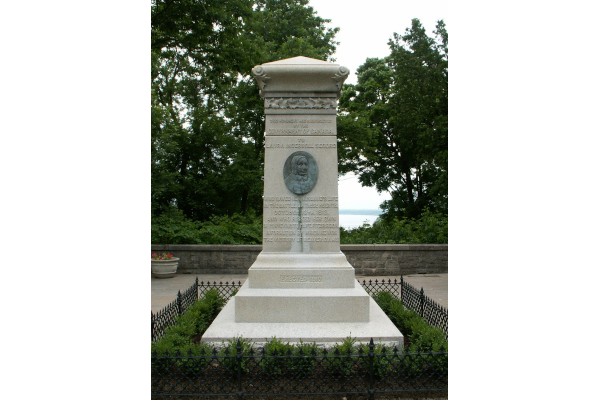
A 7-foot granite monument commemorating Laura Secord’s bravery and heroism in warning the British forces of a planned American attack on Niagara Peninsula stands in Queenston Heights Park since 1910, overlooking the Niagara River.
Early feminist groups and members of the United Empire Loyalist Association initiated the monument’s creation, and the government-funded it. It has a Bas-relief portrait of Secord and an inscription that reads: “To Laura Ingersoll Secord, who saved her husband’s life in the battle on these Heights October 13th, 1812 and who risked her own in conveying to Capt. FitzGibbon information by which he won the victory of Beaverdams.”
Laura Secord (1775-1868) was born in Great Barrington in the colonial Province of Massachusetts Bay. In 1795, she moved with her family and other Loyalist refugees to Queenston in Upper Canada, where she met and married James Secord.
When the War of 1812 broke out between the US and the United Kingdom and its British North America allies, Secord’s husband served in the 1st Lincoln Militia. When she heard he was severely wounded, she rushed to his side and begged for his life from the American soldiers, who presumably were about to beat him to death.
By June 1813, the Americans had occupied Fort George, Queenston, and the Niagara area. On June 21st, 1813, Secord overheard the American plans for a surprise attack of British troops at Beaver Dams. She embarked on a 20 miles walk from Queenston to the British headquarters in Thorold Township to warn Lieutenant James FitzGibbon of the impending attack. Based on her intel, the British and their Mohawk allies were well prepared and defeated the Americans.
Secord’s story did not become famous until the late 1880s, when feminist groups discovered it and made it a pillar of women’s suffrage. Throughout the years, her bravery and devotion have been the subject of books, poetry, and plays, while gaining mythic status in Canada.
A 10-minute walk from the monument stands the Laura Secord Homestead. A museum that tells the story and legacy of Secord in the house she lived during 1803-1835.
This post is also available in:
 Español
This post is also available in:
Español


