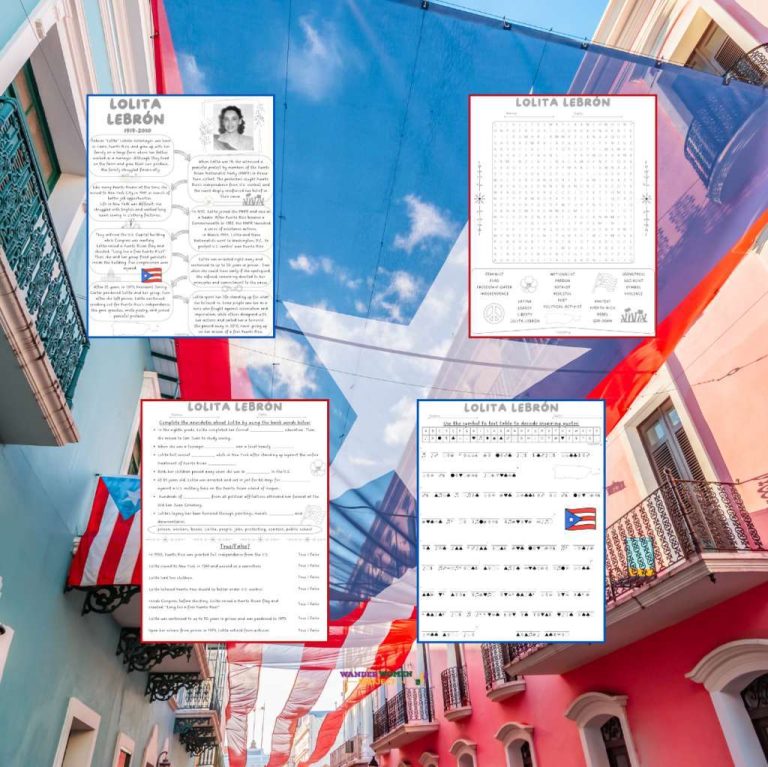
This engaging worksheet introduces students to the inspiring life of Lolita Lebrón (1919-2010), a Puerto Rican nationalist who dedicated her life to fighting for Puerto Rico’s independence.
The first page highlights key moments from Lolita’s life, from her early years in Puerto Rico to becoming a leader in the Puerto Rican independence movement. She gained worldwide attention in 1954 when she led an armed attack on the U.S. Capitol, which resulted in her imprisonment for 25 years. After her release, Lolita remained a dedicated activist, advocating for Puerto Rico’s freedom and social justice through speeches, poetry, and peaceful protests.
Flip to the second page for an interactive experience!
Spark curiosity with a delightful word completion game featuring fascinating facts about Lolita.
Plus, check students’ understanding with True/False questions.
The third page includes Lolita’s life-themed word search puzzle.
On the fourth page, students will embark on a decoding challenge using the symbol-to-text table provided; they will turn the symbols into letters and unravel Lolita’s inspiring quotes.
Students can choose their favorite quote, write it on a separate piece of paper, and display it on the classroom walls to inspire everyone.
This activity is perfect for Women’s History Month (March), International Women’s Day (March 8th), National Latina Day (August 20), ), Women’s Equality Day (August 26th), National Hispanic Heritage Month (September 15 to October 15), her birthday (November 19th), and English, Science, and Social Studies classes.
As educators, it is our responsibility to present a comprehensive history to future generations and emphasize that the world, as it is today, is a product of the works and achievements of both men and women.
Although more than before, the official curriculum still lacks space for women’s history, stories about pioneering women, and their influence on society.
Therefore, it is essential to proactively include content about women, providing children with role models and examples to identify with while teaching them that women are equal, and have made significant contributions to history.
Education is one of the most important ways to inspire and create a more equal society for us and future generations.
This post is also available in:
 Español
This post is also available in:
Español


