
Washington, DC, USA
In the exhibition hall at the US Capitol stands the statue of Sakakawea (also Sacagawea, Sacajawea), representing North Dakota to the National Statuary Hall Collection (NSHC).
In 1999 North Dakota state legislature approved the donation of the statue of Sakakawea to the NSHC. The statue committee decided to send a replica of the Sakakawea statue that has been standing on the North Dakota State Capitol grounds since 1910.
The State Historical Society and the General Federation of Women’s Clubs of North Dakota worked for more than three years to raise $200,000 for the 1,200-pound bronze casting of the statue.
The Women’s Clubs of North Dakota, then called the North Dakota Federation of Women’s Clubs, also commissioned the original statue and chose Leonard Crunelle to sculpt it. That was one of the first sculptures that honored a woman in the nation. The North Dakota Federation of Women’s Clubs erected it in celebration of the contribution of North Dakotan women to the history of the US. To create an authentic depiction, Crunelle traveled to the Fort Berthold Reservation in North Dakota to sketch Hidatsa figures, learn their costumes, and meet Sakakawea’s granddaughter, Hannah Levings Grant, also known as Mink Woman, who modeled for the statue.
Since each state can honor two figures and the Sakakawea statue also depict her son, only she appears on the plaque that reads:
“North Dakota
Sakakawea
A member of the Lewis and Clark expedition
1804-1806”
Still, North Dakota is the only state that presents three figures in the NSHC.
Her statue was the first nonwhite woman in the NSHC and the 7th of a woman. Two years later, Nevada donated Sarah Winnemucca’s statue to the NSHC. Sakakawea and Winnemucca, along with a depiction of Pocahontas in a painting, are the only Native-American women included in the US Capitol.
The statue’s dedication was part of the bicentennial of the Lewis and Clark Expedition. Members from the Three Affiliated Tribes participated and performed in the dedication ceremony on October 16th, 2003.
Sakakawea(b.1788, death unknown) was a Native-American woman who was one of the members (and the only woman) of the Lewis and Clark expedition to the Pacific Ocean. She was born into the Shoshone tribe in what is now Idaho. Around the age of 12, Hidatsa Indians captured and took her to live with them in the area that is now North Dakota. Several years later, they sold her to marry a French-Canadian fur trader. In 1804, Lewis and Clark came to the area to prepare for the expedition to the wild west; they hired her husband and took her as an interpreter for the Shoshone people. She gave birth to her son, Jean Baptiste, and carried him on her back on the journey. Sakakawea had a significant role in the expedition’s success, contributing as a diplomat, guide, and translator. Read more...

Fort Collins, CO, USA
In September 2021, Temple Grandin made history again when her sculpture was dedicated at Colorado State University as the first one to honor a woman on the campus and one of the few in the world to honor an autistic woman.
Temple Grandin is a professor of animal sciences at Colorado State University, animal behavior expert, innovator, livestock industry consultant, author, and autism activist.
Grandin was born in 1947 and grew up in a wealthy family in Boston, Massachusetts, the oldest of four children. Her mother, Anna, noticed Grandin’s slow behavior development and consulted doctors who diagnosed Grandin with “brain damage” caused by an insufficient bond with her mother. Anna refused to institutionalize Grandin and supported her with a speech therapist and governess. After several years Grandin started attending school with some support and accommodations. Her adolescent years were challenging due to her parents’ divorce and social challenges at school. At 14, she started attending a boarding school in New Hampshire. The small farm they had was her first encounter with agriculture. A year later, she spent the summer on her aunt’s ranch in Arizona and fell in love with the culture of the West and cattle.
After graduating high school in 1966, Grandin earned her bachelor’s degree in human psychology from Franklin Pierce College (1970), master’s degree in animal science from Arizona State University (1975), and doctoral degree in animal science from the University of Illinois at Urbana–Champaign (1989). Then, she became faculty in Colorado State University, teaching, researching, and inspiring students.
Since the 70s, she has worked as a consultant in the meat and livestock industry, saying that at the beginning, it was harder to prove herself as a woman than an autistic person.
Grandin published several books about autism, writing about her experience and recommending methods that helped her. She is a public speaker about the subject and an advocate for autism rights.
CSU alumnus Jeff Tovar commissioned the life-size bronze sculpture, and the artist David Anderson created it depicting Grandin sitting on the ground and looking at the horizon. Read more...

Virginia Beach, VA, USA
The statue of Grace White Sherwood, also known as the Witch of Pungo, honors her legacy as a healer and herbalist and commemorates her unfair treatment.
Grace White Sherwood (1660-1740) was a farmer, healer, midwife, and mother of three who lived with her husband on a farm in Pungo (today, part of Virginia Beach), Virginia. Sherwood’s neighbors accused her several times of witchcraft, accusing her of many accusations, from casting a spell on their animals and cotton crops to transforming into a black cat; Sherwood had to defend herself in court and lost most of the cases.
In 1706, she was already a widow and was taken to court on the accusation of bewitching her neighbor and causing her a miscarriage. The court investigated ways to prove she was a witch, searching her home and examining her body. When two “witch marks” were found on her body, the court ordered the ducking test to check her purity. She is a witch if she floats and innocent if she sinks.
On the morning of July 10th, 1706, in Lynnhaven River near today Witchduck Road, in the presence of a large crowd, Sherwood was thrown into the river; she succeeded in untying herself and floating.
She was sent to jail and spent there about eight years. Afterward, she claimed farm ownership and lived there until her death.
There are many legends about her death; some say that her body disappeared through the chimney, that her devil took it, others that unnatural storms happened after she died, and many other stories.
In 1973, Virginia Beach historian and author Louisa Venable Kyle wrote a children’s book about Sherwood, bringing Sherwood’s story back to the public attention. 300 years after her conviction, on July 10th, 2006, Governor Tim Kaine cleared her name with an informal pardon.
About a year later, on April 21st, 2007, her statue by Robert Cunningham was dedicated at the junction of Independence Blvd and North Witchduck Road on the grounds of the Sentara Independence hospital. Sherwood is depicted as a healer holding a basket of rosemary and standing alongside a raccoon, representing her love of animals. Bronze plaques on the base tell her story, the story of the trial, and present a copy of the governor’s pardon letter. Read more...

Milwaukee, WI, USA
Sojourner Truth’s bronze statue stands outside the emergency domestic violence shelter for women and children, which also bears her name. It was dedicated on the same day as the new campus on April 25th, 2016, in a special ceremony that included a reading of Truth’s famous speech: “Ain’t I A Woman.”
Sojourner Truth (1797-1883) was born into slavery by the name Isabella Baumfree. She was sold and transferred between several masters and sometimes suffered from physical and sexual abuse.
In 1826, she escaped to freedom with her infant daughter. Two years later, when she discovered that her son was sold to a new owner in Alabama, she sued the new master and won, becoming the first black woman to file and win a case against a white man in court.
In 1843, she answered the spirit of God’s call, changed her name to Sojourner Truth, and became a public preacher and speaker, devoting her life to advocating for abolition and women’s right.
Sojourner Family Peace Center was established in 1975 and named after the national heroine Sojourner Truth, who was a victim of violence and abuse and transformed her life to promoting peace, love, and equality for African-Americans and women. It is Wisconsin’s largest nonprofit provider of domestic violence prevention and intervention services. Read more...

Battle Creek, MI, USA
On September 25th, 1999, the Battle Creek community dedicated a statue to celebrate and commemorate the legacy of the national heroine, Sojourner Truth, who chose Battle Creek as her home in the last 26 years of her life. The statue, alongside educational programs, is one of the many actions the community has taken to commemorate Truth’s legacy and continue her work promoting equality.
The renowned California artist, Tina Allen, designed a 12-foot-tall sculpture of Truth, the world’s largest statue of Truth.
Sojourner Truth is depicted during a public speech, standing on a podium, facing a seating area, next to a lectern that holds a bronze plaque with information about the monument and her story. The last sentence inspires the visitors to follow her legacy “…It is for each of us who stand here to carry on the work of truth.”
On the stonewall behind the statue is a plaque with her signature, which she wrote in an autograph book owned by a local high school student on April 23rd, 1880.
Two other bronze plaque presents her quotes –
“…and Truth shall be my abiding name.”
“Lord, I have done my duty and I have told the truth and kept nothing back.”
Facing the statue is a bronze plaque with her short biography:
“Sojourner Truth was born as the slave Isabella in New York State about 1797. As a child she spoke only low Dutch and, like most slaves, she never learned to read or write. While she was in bondage, she married Thomas, a fellow slave, and had five children. She was sold to four new owners before walking away to freedom in 1826. Isabella then settled in New York City until 1843, when she changed her name to Sojourner Truth. Relying on her deep religious faith, she was determined to travel the land as an itinerant preacher, speaking the truth and fighting against injustice. She became a prominent figure in several national social reform movements, working for the abolition of slavery, women’s rights, temperance, prison reform, and the rights of former slaves. Sojourner first came to Battle Creek in 1856 to speak to the Quaker Friends of Human Progress. She moved to the area a year later and lived here for the last twenty-six years of her life. She died on November 26, 1883, and is buried in Oak Hill Cemetery. Sojourner Truth was perhaps the most famous African American woman in 19th century America. For over forty years she was a passionate advocate for the dispossessed, using her quick wit and fearless tongue to fight for human rights. May her legacy live on.” Read more...
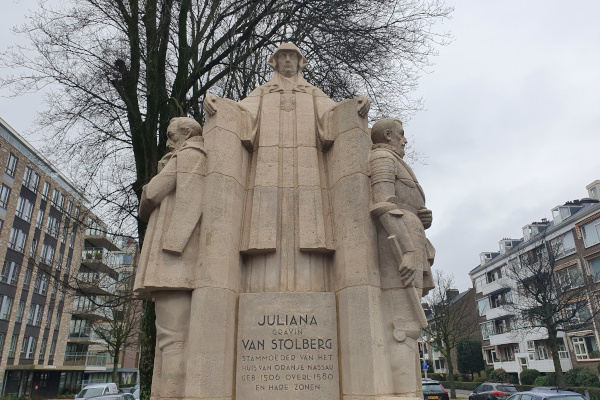
The Hague, Netherlands, Europe
Juliana van Stolberg (1506-1580) was born and lived most of her life in Germany. At 14, she married Count Philip of Hanau-Munzenberg, and together they had five children. In 1529, Philip passed away, and she married Willem de Rijke. Together they had twelve children; seven daughters and five sons. Her son, William of Orange, led the successful Dutch rebellion against Spain for independence. His brothers also fought the battle, and some even died during the war.
Three hundred years after Juliana van Stolberg passed away, old letters revealed that she was not only the mother of five of the commanders of the Dutch rebellion but that she had a significant role as a consultant and financial supporter.
Inspired by her actions, Queen Wilhelmina named her first daughter and heir to the throne, Princess Juliana, in her honor.
On April 30th, 1927, on her 18th birthday, Princess Juliana laid the monument’s cornerstone; three years later, she unveiled it in the presence of Queen Wilhelmina and Queen Mother Emma on the Louise de Colignyplein in The Hague.
The sculptor Bon Ingen-Housz and the architect Dirk Roosenburg created it. They depicted Juliana van Stolberg in a tall stone heptagonal sculpture standing alongside her five sons – William I of Orange (Willem van Oranje), John VI “the Elder” (Jan van Nassau-Dillenburg), Louis of Nassau (Lodewijk van Nassau), Adolf (Adolf van Nassau), and Henry (Hendrik van Nassau).
Inscribed below Juliana is the following text:
“Juliana
Countess
van Stolberg
ancestress of the
House of Orange Nassau
b. 1506 deceased. 1580
and her sons”
On March 3rd, 1945, the British air force bombed the area causing the death of 500 people. The statue was barely scratched; in 1954, when the Bezuidenhout got rebuilt, the monument moved to the corner of Koningin Marielaan and Juliana van Stolberglaan, serving as a memorial to the 500 victims of the bombardment of Bezuidenhout.
A 10-minute walk will get you to the beautiful and spacious Haagse Bos park. Read more...

The Hague, Netherlands, Europe
In the center of the square on the avenue that bears her name, a bronze statue of the Queen of the Netherlands, Anna Pavlovna of Russia, is sitting on a bench, looking at and mingling with the visitors of the square while holding a decorated hand fan. The Russian sculptor Alexander Taratynov created it in 1999.
Anna Pavlovna of Russia (1795-1865) was born to the title Her Imperial Highness Grand Duchess Anna Pavlovna of Russia in the royal family of Russia. In 1816, Pavlovna married the Prince of Orange, who became King William II of the Netherlands in 1840. Together they had five children.
She had difficulty accepting the cultural differences between her home country and the Netherlands, specifically with the lack of distance between the royals and the commoners. As a princess and later as queen, Pavlovna learned the Dutch language, history, and culture; she focused on charity work, financing many orphanages and schools and establishing charity organizations.
In 1849, after the unexpected death of her husband, she retired from royal life and lived privately and a bit alone until she died in 1865.
Around the square are some lovely local restaurants. Panorama Mesdag museum and Noordeinde Palace are within walking distance to the east. Heading north from the statue will lead to the De Mesdag Collectie art museum and the Peace Palace. Read more...

Angola, IN, USA
When the Downtown Angola Coalition received the Preserving Women’s Legacy Grant to celebrate Indiana women’s suffrage centennial, they chose to dedicate a statue to Sojourner Truth, who had visited Angola in 1861 and delivered a speech on the stairs of the Steuben County Courthouse on June 2nd, 1861.
The Colorado artist (originally from Indiana) Jim Haire created the life-size bronze statue, depicting her as she was when she came to Angola to speak in 1861, wearing traditional Quaker clothes, holding her cane on the right and a paper with an invitation to her free lecture in her left.
A nearby bronze plaque describes Truth’s connection to Angola and the story behind the statue and its dedication.
The statue was dedicated in a special ceremony on June 6th, 2021, attended by hundreds of people, including Truth’s descendants, local and state officials, and Lieutenant Governor Suzanne Crouch. It is a historical landmark and serves as a memory of Steuben County’s role in the abolitionist movement.
Sojourner Truth (1797-1883) lived for almost 30 years as an enslaved woman by Isabella Baumfree in New York. She had several owners, got married, and had five children. In 1826, she escaped with her infant daughter and got help to buy her freedom. She settled in New York City and worked as a domestic. In her forties, she answered the Spirit of God’s call to spread the truth. She changed her name to Sojourner Truth and became a preacher and public speaker, dedicating her life to promoting equal society for African-American women. She traveled the country and lectured about abolitionism and women’s rights in hundreds of communities. In 1861 Truth arrived to speak in Angola, Indiana, and stayed there for a few weeks. On the stairs of the Steuben County courthouse, wearing a red, white, and blue dress, she spoke about the abolition of slavery and women’s rights. Read more...

Battle Creek, MI, USA
This Underground Railroad sculpture commemorates the people in the Battle Creek area who assisted enslaved people to freedom while risking their lives.
During the 1840s and 1850s, fleeing enslaved people passed through Battle Creek on their way to Canada. People, mainly Quakers, in the area provided them with a safe place, protected them from slave catchers (after the US Congress passed the Fugitive Slave Law in 1850), and helped them reach the next station safely.
Kellogg Foundation commissioned Ed Dwight to design the memorial in 1993, and it was dedicated on October 24th, 1993, near the Kellogg House. Among the other monuments the foundation generously funded in Battle Creek is a statue of the abolitionist and women’s rights activist Sojourner Truth that sculptress Tina Allen designed in 1999.
At 28 feet long and 14 feet high, it is the largest Underground Railroad monument worldwide.
It depicts the famous Underground Railroad conductor Harriet Tubman (1822-1913) while guiding a group of enslaved to freedom. She stands next to the local abolitionists, Underground Railroad conductors, and station masters Sarah Bowen Hussey (1808-1899) and her husband Erastus Hussey (1800-1889) as they help enslaved people to a safe place.
Erastus Hussey was a politician who advocated for abolition and was an editor in the Michigan anti-slavery publication: Liberty Press. The Husseys have helped more than a thousand fugitive slaves to freedom.
Harriet Tubman was born into slavery on the Eastern Shore of Maryland. In her late twenties, she escaped and became a free woman who made it her life mission to free as many enslaved people as possible. Tubman became an Underground Railroad conductor, returned to Maryland 19 more times, and helped tens of people escape slavery. During the civil war, she led hundreds to freedom as a scout and spy in the Union Army. She continued advocating and working for equal rights till her last days.
The Bronze plaque reads:
“Memorial to the Underground Railroad.
From the 1830s to 1861, thousands of slaves in the southern United States courageously escaped northward to freedom to what became known as the Underground Railroad. Along this secret network, ‘conductors’ like Battle Creek’s Erastus and Sarah Hussey, whose likenesses are captured in this memorial, took great personal risks to ensure the safety of escaping slaves. Harriet Tubman, known as the Black Moses, was a national heroine of this epic struggle and is depicted leading another brave family away from the shackles of slavery.
This memorial honors the Underground Railroad and is dedicated to the strength of the human spirit in the quest for freedom.
Ed Dwight, Sculptor.
Denver, Colorado. 1993.
This sculpture was made possible by a gift from the Glenn A. Cross Estate and the W. K. Kellogg Foundation.”
Click here to explore places about Harriet Tubman and here to read about women abolitionists on the Underground Railroad. Read more...

Claremont, CA, USA
The first sculpture that was dedicated at Scripps College’s new sculpture garden was unique not only because it was the first but also for the following reasons:
1. This sculpture honors Harriet Tubman, who freed herself from the shackles of slavery and became a civil rights activist and iconic conductor of the Underground Railroad, guiding hundreds of enslaved people to freedom.
2. This is Tubman’s first statue on the west coast.
3. Alison Saar is the contemporary American artist who created it, and she is an alumna of Scripps College, a women’s college founded by Ellen Browning Scripps in 1926.
Tubman’s statue is a reduced version of the 13-foot bronze statue that has stood on the Harriet Tubman Triangle in Harlem, New York City, since 2008. The college dedicated it on national Harriet Tubman Day, March 10, 2010, in a special ceremony that was part of the college’s yearlong celebration of “The Genius of Women” celebrating the inauguration of its eighth president, Dr. Lori Bettison-Varga.
The ceremony included a gospel performance, speeches by the college president, Dr. Lori Bettison-Varga, the artist Alison Saar, and Professor Emerita Samella Lewis, and a poem recitation by the poet Lynne Thompson (’72 alumna), which she wrote for the dedication.
This standing sculpture of Harriet Tubman (1822-1913) tells her life story. She is depicted in motion, the roots of slavery on her back; while they try to pull her back, she is unstoppable and continues forward. Her skirt has prints of the faces of the people she rescued from slavery, as if she is the train that carries them to freedom.
The statue’s base is surrounded by tiles with symbols representing moments from Tubman’s life and traditional African-American quilting signs. Read more...

