
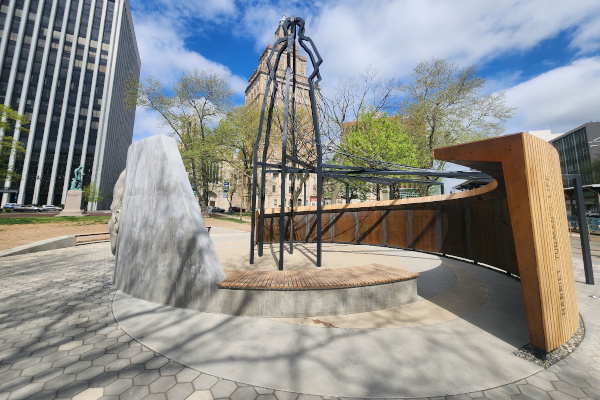
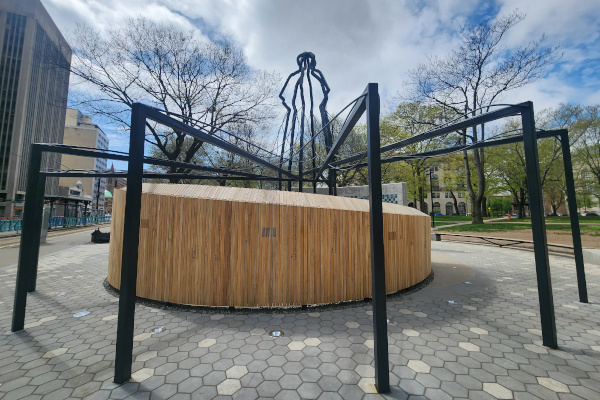
Located in the heart of Newark, a remarkable monument celebrates Harriet Tubman and the Newark Black Liberation Movement.
In June 2020, following the protests that took place after the murder of George Floyd, the city of Newark decided proactively to remove Christopher Columbus’ statue and, as Newark Mayor Ras J. Baraka said, “erect a monument that spurs us into our future story of exemplary strength and solidity.”
The monument committee chose the design of the multidisciplinary designer and the founder of Studio Cooke John Architecture and Design, Nina Cooke John, named it “Shadow of a Face,” based on Robert Hayden’s 1962 poem “Runagate Runagate,” which references Tubman, and dedicated it on March 9th, 2023, (a day before the annual Harriet Tubman Day) in the Harriet Tubman Square.
The 25-foot-tall monument consists of a large open circle that presents on one wall a mosaic of tiles created by Newark residents; the other wall showcases key milestones of Tubman’s life and the Underground Railroad in Newark. On the other side of the tile wall is a large-scale portrait of Tubman, placed at the visitor’s eye level. The singer, actor, and Newark native Queen Latifah narrates the audio installation.
Harriet Tubman was born into slavery between 1815 and 1825 on the Eastern Shore of Maryland. In 1849, she escaped to Pennsylvania and became free. Soon after, Tubman risked her freedom and returned 19 more times to Maryland as a conductor of the Underground Railroad to free tens of people, including her family. To finance the rescue expeditions and to financially support the former slaves on their first days as free people, she worked as a domestic and cook. In the early 1850s, Tubman worked during the summers in Cape May, New Jersey. During the civil war, she served in the Union Army as a cook, nurse, spy, and scout, leading an armed expedition that freed hundreds of enslaved people. After the war, she retired to her home in Auburn, New York, advocated for women’s suffrage, and co-established a home for elderly people, where she spent the last years before she died in 1913.
The monument is the second tribute to the brave activist in New Jersey. The first took place in 2020 with the opening of the Harriet Tubman Museum in Cape May.
The memorial stands near the Newark Museum of Art, and a statue of Rosa Parks is a mile away.
Mary McLeod Bethune, an educator and civil rights leader, is honored with a statue in the nearby Jersey City.
This post is also available in:
 Español
This post is also available in:
Español


