
London, England, UK
In front of the Theatre Royal Stratford East stands the statue of Joan Littlewood, the theatre director who became known as “The Mother of Modern Theatre.”
Joan Littlewood (1914-2002) was born in London. At the Royal Academy of Dramatic Art, she studied acting. Dissatisfied, she left after one year to live in Manchester. There, she joined Ewan MacColl’s Theatre of Action and married him. In 1936, they formed the Theatre Union. In 1945, Littlewood, her husband, and other Theatre Union members established the Theatre Workshop and the following years, performed around the country.
In 1953, the Theatre Workshop relocated to the Theatre Royal in Stratford, east London. As the company’s director, Littlewood advocated for the representation of the working-class people, providing a platform for their voices and stories, and broke the barriers between ‘artistic’ and ‘popular’ theater.
The Theatre Workshop gained a local and international reputation and performed in theaters in Europe and on Broadway. In 1963, Littlewood became the first woman to receive a Tony Award nomination for Best Direction of a Musical for Oh, What a Lovely War!
Retired in 1975, she moved to France and wrote the memoir of her companion, Baron Philippe de Rothschild, and her own autobiography, Joan’s Book. She died at the age of 87.
The Theatre Royal Stratford East decided to erect a statue in Littlewood’s honor as a permanent reminder of her contribution to the theatre. They commissioned artist Philip Jackson, who also made the Queen Mother Memorial in The Mall, and the Bomber Command Memorial Sculpture in Green Park.
Unveiled on October 4th, 2015, under the name The Mother of Modern Theatre, the life-size bronze statue was based on an iconic photograph of Littlewood sitting on rubble when the Theatre Royal Stratford East got threatened with demolition in the 1970s.
The Joan Littlewood Statue stands close to many monuments and sites, such as the Stratford Martyrs Memorial, the Samuel Curney Memorial, the Discovery Children’s Story Center, and the Queen Elizabeth Olympic Park. Read more...

London, England, UK
The statue of Sarah Siddons, the most famous actress of the 18th century, stands in her burial site in Saint Mary’s Cemetery at Paddington Green.
Sarah Siddons (1755-1831) was born in Brecon, south Wales, in a theatrical family; her father was an actor and theatre manager, her brother was an actor’s manager, and she, alongside three of her siblings, joined her father’s company. At 15, she worked as a lady’s maid in Warwickshire and developed her acting talent, reciting poetry before her lady’s aristocratic friends.
At 18, she married William Siddons, an actor in her father’s company; they had seven children together. After the wedding, she moved to London, returning to perform, and in 1774, the 19 years old actress received her first recognition for her portrayal of Belvidera in Thomas Otway’s Venice Preserv’d. She joined a touring company and performed across the country, earning a reputation as a gifted tragedienne.
In 1782 she returned to London and fascinated the audience with her expressive and powerful portrayal of tragic Shakespearean characters, such as Lady Macbeth, Ophelia, and Desdemona. She became the most famous actress of her time, retiring at age 57. She died twenty years later.
The life-size white marble statue of Siddons was the first sculpture of an actor in London (excluding Shakespeare) introduced in 1897. The French sculptor Léon-Joseph Chavalliaud created it based on the 1784 portrait by Sir Joshua Reynolds Sarah Siddons as the Tragic Muse. It depicts her wearing a classical costume, sitting regally with a dagger in her hand and a mask under her chair.
In 2011, the statue was heavily vandalized but got repaired and restored in 2019. Another statue of Siddons stands in the Chapel of St Andrew in Westminster Abbey. The Sarah Siddons Statue in Paddington Green is within walking distance from many sites, including the Paddington Bear Statue, Sherlock Holmes Statue, and Hyde Park, where you can visit the Queen Victoria statue and the Diana Princess of Wales Memorial Fountain. Read more...

London, England, UK
On the Albert embankment path, overlooking the River Thames stands the Violette Szabo bust, also known as the Monument SOE Agents, which commemorates the heroism of Szabo and the women and men who risked their lives serving as secret agents during WW2.
Violette Szabo (1921-1945) was born in Paris, France, and grew up in London. At the outbreak of WW2, she joined the Women’s Land Army and later to the Auxillary Territorial Service. In 1940, she met Étienne Szabo, a decorated French soldier who was 12 years her senior. After 42 days, they got married. In June 1942, she gave birth to their daughter, Tania, and several months later, her husband died in the battle of El Alamein.
The 22 years old Szabo got recruited to the Special Operation Executive, SOE, a secret organization that operated behind enemy lines in occupied Europe. After extensive training as a field agent, she was sent on several missions in France to gather intelligence and organize sabotage operations.
On June 10th, 1944, while on a mission with the local resistance, Szabo’s team got involved in a gun battle with the Germans. In their attempt to flee, she twisted her ankle and had to slow down while covering fire for her teammates and allowing them to escape.
She was captured, interrogated, raped, and tortured by the Nazi Germans and eventually sent to Ravensbrück, a concentration camp in Germany. On February 5th, 1944, she was executed with a shot to the back of her head. She was 23 years old. After her death, she received the George Cross (the second woman), the Croix de Guerre, and the Médaille de la Résistance.
The Violette Szabo bust serves as a memorial to all SOE agents and honors their courage and sacrifice. The sculptress Karen Newman created it, and the Duke of Wellington unveiled it on October 4th, 2009.
Several commemorative plaques are on the plinth.
The front plaque is dedicated to all SOE agents. It states, “[…] This monument is in honour of all the courageous S.O.E. Agents: those who did survive and those who did not survive their perilous missions. Their services were beyond the call of duty. In the pages of history, their names are carved with pride.”
The plaque on the southern side of the plinth is dedicated to the Maquis, the French Resistance Fighters who collaborated with the SOE in the fight to liberate France in 1944, and to Violette Szabo, “[…] who was among the 117 SOE agents who did not survive their missions to France.”
The plaque on the northern side of the plinth is dedicated to the Heroes of Telemark, the Norwegian resistance commandos sponsored by the SOE.
Many nearby landmarks and attractions reside on or nearby the Albert embankment path, including the Florence Nightingale Museum, the Mary Seacole Memorial Statue, the Garden Museum, the London Eye, and many more. Read more...

London, England, UK
Resided inside St Thomas’ Hospital, where she established her nursing school in 1860, the Florence Nightingale Museum celebrates and honors the life and work of the founder of modern nursing.
The Florence Nightingale Museum Trust opened the museum in 1989 and has been running it since. Through three pavilions, the museum follows Nightingale’s life, from her aristocratic upbringing, her journey to becoming a nurse, her work during the Crimean War, and her campaigns for better healthcare and improving the practices and reputation of nursing.
The collection holds many of Nightingale’s personal items, including her pet owl, the medicine chest she took to Crimea, and the iconic lamp which earned her the nickname “The Lady With The Lamp”. There are also artifacts related to nursing history, such as a Register of Nurses that lists women who served under Nightingale in the military hospital in Crimea. The museum archives preserve approximately 800 letters Nightingale wrote and a rare book collection.
Florence Nightingale (1820-1910) was born in an upper-class family. She was a compassionate child and supported the poor and the ill in the nearby village. At 30, she went to study nursing in Germany, and on her return, she took a job as a nurse at a hospital in London; within a year, she got promoted to head of nursing. During the Crimean War, the British Army recruited her to reorganize and operate the hospital in Scutari. There, she supervised the nurses, attended to the wounded soldiers, and improved the hygiene and sanitation conditions.
She promoted the importance of mental health to recovery, so at night she walked the wards, holding her lamp and keeping company with her patients. After only six months, she reduced the hospital’s mortality rate from 42% to 2%.
She returned to England as a hero and received a medal and a grant from Queen Victoria. She used the funds to establish the Nightingale School of Nursing at St. Thomas’ Hospital. In this hospital, she redefined the nursing profession, modernized its working methods, and introduced it as a respectable job for women. She also campaigned for healthcare reforms and assisted in establishing other health facilities and programs, including the midwives’ school at King’s College Hospital and the district nursing training program for improving home health care for the poor.
Outside St Thomas’ Hospital stands the statue of Mary Seacole, a pioneer nurse and businesswoman who served as an independent nurse during the Crimean War. Upon its dedication in June 2016, it was the first statue of a black woman ever erected in the UK.
A statue of Nightingale is located just across the Thames in Waterloo Place. Nearby worth vising sites include Westminster Abbey, the Palace of Westminster, Big Ben, and the Emmeline and Christabel Pankhurst Memorial in Victoria Tower Gardens. Read more...

London, England, UK
The Margaret MacDonald Memorial stands near her family home in Lincoln’s Inn Fields, honoring the feminist and social reformer Margaret MacDonald, who dedicated her life to improving working women’s conditions.
Margaret Ethel MacDonald (1870–1911) was born in London. Her parents homeschooled her before she attended the Doreck College for Girls in Bayswater and the women’s department of King’s College London. In her 20s, MacDonald became a socialist and joined the Women’s Industrial Council. During her work, she met Ramsay MacDonald, who later became the first Labour prime minister, and the couple married in 1896. After the wedding, they moved to 3 Lincoln’s Inn Fields, had six children, and lived there until her death.
MacDonald became more involved with promoting the needs and conditions of working women, and in 1904, she helped to establish the first trade schools for girls. She was also an active member of the National Union of Women Workers and the National Union of Women’s Suffrage Societies. In 1906, MacDonald co-founded the Women’s Labour League and chaired it for the next five years. She died in 1911 at the age of 41.
The Margaret MacDonald Memorial, allegedly designed by her husband, was created by Richard Reginald Goulden and unveiled on December 19th, 1914.
It comprises a granite alcove seat below a bronze sculptural group in which MacDonald appears kneeling and extending her arms to protect nine figures of angelic-like playful infants. An inscription engraved on the granite reads: THIS SEAT IS IN MEMORY OF MARGARET MACDONALD WHO SPENT HER LIFE IN HELPING OTHERS. A plaque on the back of the seat details her biography, achievements, and characteristic as a loving and joyful person. In 1974 the memorial became a grade II listed structure.
Within walking distance of the memorial, there are many sites to visit, including the Sir John Soane’s Museum, the Museum of Freemasonry, and the filming location of 12 Grimmauld Place – the ancestral home of Sirius Black from the Harry Potter film series. Read more...
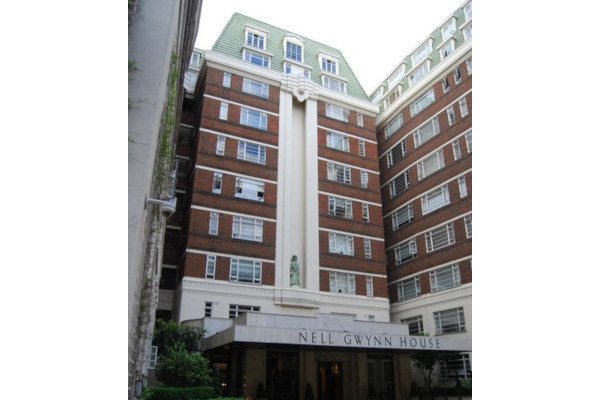
London, England, UK
A statue of Nell Gwynn, one of Britain’s first actresses who became known as the mistress of King Charles II, stands above the entrance of a residential building named after her.
Eleanor Gwyn (1650-1687) was born in London to a low-class family and lived in the slum area of what is now known as Covent Garden. In 1660, Charles II regained the English throne; he removed the decade-long ban on theaters the Protectorate administration had dictated and the prohibition on female actresses. Soon after, Gwynn joined the Bridges Street Theatre, and by 1665 she became one of the most popular actresses of the time. When the theaters closed due to the Great Plague of London, she traveled with a theater company to entertain the King’s court in Oxford.
It was then when the King probably became acquainted with the young actress, but their relationship allegedly began a few years later, in 1668. She continued to perform at the King’s House, and her new status as the King’s mistress drew larger crowds, and several playwrights have written roles specifically for her. Though the King was married and had various companions, he declared Gwyn his favorite, they had two children, and the couple maintained their relationship throughout his life. On his deathbed in 1685, he swore his brother and successor, King James II, to take care of Gwyn, saying: “Let not poor Nelly starve.” She died two years later, at the age of 37.
Her statue stands in an alcove above the entrance of Nell Gwynn House in Sloane Avenue, Chelsea.
The Art Deco apartment building was designed in 1937 by George Kay Green. Though Sloane Avenue lies close to King’s road, King Charles II’s private road between his palaces in St James’ and Hampton Court, Gwyn herself had no relation to the location of Nell Gwynn House.
The statue depicts her in 17th-century aristocratic clothing, and a Cavalier King Charles spaniel rests at her feet. It is likely to be the only statue of a royal mistress in London.
The relationship between Gwynn and the King is portrayed in a bas-relief at the Venus fountain in Sloane Square, a short distance from Nell Gwynn House. Other nearby sites are Saatchi Gallery, the Chelsea flower showgrounds, and the National Army Museum. Read more...

London, England, UK
On top of the Victoria Palace Theatre stands the statue of the prima ballerina Anna Pavlova.
Anna Pavlova (1881-1931) was born in St. Petersburg, Russia. At 10, she got accepted to the Imperial Ballet School, and after graduating, she entered the school’s company: The Imperial Ballet. Pavlova quickly rose through the ranks, and in 1906, at the age of 25, she was named prima ballerina. In 1909, she joined the newly founded Ballets Russes but left the following year to establish her own company.
In 1912, she moved to London and settled in the Ivy House, where she lived for the rest of her life. Pavlova and her company were the first to tour worldwide, performing in places where people had never seen ballet before, including Australia, India, and South America. She also was a leading figure in the development of British ballet. She died at the age of 50.
In 1911, the Victoria Palace Theatre owner, Alfred Butt, who had supported her career since she arrived in the UK, commissioned the theatre’s architect, Frank Matcham, to sculpt Pavlova’s statue and placed it atop the dome. In 1939, with the outbreak of WW2, it was taken down for safekeeping but was lost when the war ended. The faith of the original statue remains unknown. In 2006, the sculptor Hary Franchetti created a replica of the statue based on a photo of the original sculpture.
The larger-than-life-sized gilded statue depicts Pavlova wearing a classical tutu, standing in the arabesque position, with one leg in the air, her arms fully extended, tilting her head toward her right hand. Pavlova superstitiously hated the idea of a statue of her and refused to look at it.
The Anna Pavlova Statue is one of at least five memorials for the prima ballerina in London. In Golders Green Crematorium, there is a statue that holds her ashes, and two more sculptures of her stand on the grounds of her home at the Ivy House on Church Street. Read more...

London, England, UK
The Emmeline and Christabel Pankhurst Memorial commemorate the mother and daughter who were prominent UK suffragettes leaders.
The initiative to commemorate Emmeline Pankhurst’s legacy with a statue was the project of the Pankhurst Memorial Fund, led by the members of the Women’s Social and Political Union (WSPU), Rosamund Massey and Katherine Marshall. The Suffragette’s editor Rachel Barrett organized the fundraiser, and a Parliamentary bill approved the location in the south corner of Victoria Tower Gardens near the Palace of Westminster. The statue was created by Arthur George Walker, who also sculpted Florence Nightingale and Louisa Aldrich-Blake; both sculptures still stand in London.
It was unveiled on March 6th, 1930, by the Prime Minister, Stanley Baldwin. At the unveiling ceremony, the composer Ethel Smyth, also a member of the WSPU, conducted the Metropolitan Police Band, which included several suffragettes who were arrested together with Pankhurst during demonstrations. The band played The March of the Women, the anthem of the suffrage movement.
The bronze statue depicts Pankhurst with her arms outstretched as when she delivered a speech. A metal box inside the pedestal holds her obituary and letters.
In 1958, the statue was relocated from the south side of Victoria Tower Gardens to its current place on the north side. A low stone screen was built in front of the statue with bronze medallions at either end, one of Christabel Pankhurst’s portrait and the other of the WSPU’s “prison pin.” The renewed memorial was unveiled on July 13th, 1959.
Emmeline Pankhurst (1858-1928) was born in Manchester, England, to progressive parents who supported abolition and suffrage. Throughout her life, she has been active in various women’s rights organizations, and in 1889, she and her husband founded the Women’s Franchise League (WFL).
Over time, she realized that only militant actions would promote the cause, so in 1903, she and her daughter Christabel (1880-1958), together with other committed activists, established the WSPU, an all-women organization devoted solely to women’s voting rights. They became known for their militant methods, which included provoking the police, harassing parliament members, and vandalizing public art. Emmeline and Christabel Pankhurst, as well as other WSPU members, were sent to prison several times and often went on hunger strikes.
The mother and daughter duo’s efforts finally paid off with the passage of the law granting voting rights to all women over 21 years on July 2th, 1928, only a few weeks after Emmeline Pankhurst died.
Also in Victoria Tower Gardens are Auguste Rodin’s statue Burghers of Calais, and the Buxton Memorial Fountain commemorates the abolition of slavery in the British Empire. North of Victoria Tower Gardens is Parliament Sq, where the statue of another suffragette leader, Millicent Fawcett, has been standing since 2018. Read more...

London, England, UK
The statue of Boadicea and her daughters (also called the Boudiccan Rebellion Statue), the Celtic queen who led an uprising against Romans, stands in the heart of London, the city she destroyed thousands of years ago.
Boadicea (c.30-61 AD), also spelled Boudicca, was the queen of the Iceni, a native Celtic tribe that lived in today’s East Anglia. In 60 or 61 AD, during the reign of Nero, she led a rebellion against the Roman Empire forces and destroyed Camulodunum (Colchester), Verulamium (St Albans), and Londinium (London).
Eventually, the Iceni tribe lost, the Romans took over their territories, and Boadicea died. According to one version, when realizing the loss in coming, she poisoned herself and her daughters before being captured by the Romans; the other version claims that she was mortally wounded during the fight and was given a proper burial by her tribe. Throughout the years, mostly during the Victorian Era, Boadicea became a national symbol of British independence.
The artist and engineer Thomas Thornycroft began to work on the statue in the 1850s, with Queen Victoria and Prince Albert involved in its commission. Inspired by the parallels between the two queens, which both names mean Victory, Thornycroft sculptured Boadicea after young Victoria, and the prince’s horses were the models for the horses that pulled Boadicea.
Thornycroft died in 1885 before the completion of the sculpture, and his son, Sir John Isaac Thornycroft, took over the assignment. Lack of funding and locations delayed its installation, and it was unveiled at Westminster Bridge only in June of 1902.
The Bronze statue depicts Boadicea and her two daughters mounted on a scythed chariot drawn by two galloping horses. She is standing up in her flowing gown, holding a spear in her right hand and outstretching her left hand in a regal gesture. On the granite plinth of the statue, inscriptions were added a year after its installation; on one side, the inscription reads a quote from the 18th-century poem by William Cowper “Boadicea, an ode: Regions Caesar never knew, thy posterity shall sway.”
The Boadicea and Her Daughters Statue stands at Westminster Pier near many museums and historic sites, such as the Palace of Westminster, Parliament Square, Big Ben, the Jewel Tower, and Florence Nightingale Museum. Read more...

London, England, UK
The Louisa Aldrich-Blake Memorial commemorates the commitment and achievements of the pioneering physician who was the first female surgeon in the UK.
Dame Louisa Brandreth Aldrich-Blake (1865-1925) was born in Chingford, England. She began her academic education at Cheltenham Ladies’ College and then trained at the London School of Medicine for Women (1887-1892), graduating with honors at age 27 with a degree in medicine and obstetrics. In 1895, she obtained her Doctor of Medicine, becoming the first woman in the UK to be awarded the degree of Master of Surgery. She held several influential positions throughout her career, including the first female anesthetist at the Royal Free Hospital (1895) and Dean of the London School of Medicine for Women (1914-1925). Her leadership inspired more women to pursue a medical career.
The sculptor Arthur George Walker created the memorial in 1926. It comprises two identical bronze busts, one looking toward the garden and the other toward the street. Aldrich-Blake is depicted in her Dean’s gown, crossing her hands while holding a book. The plaque on the base lists the details of her life and career and her quotation, “Glorious is the fruit of good labour.” A semicircular stone bench is attached to the base.
Also at the Tavistock Square Gardens are the statues of Virginia Woolf and Mahatma Gandhi, as well as a cherry tree planted to commemorate Hiroshima’s victims. The sculpture of WW2 British-Indian agent Noor Inayat Khan stands at the Gordon Square Gardens across the street. Other places worth a visit nearby are the Tavistock Court, Russell Square, The British Museum, and Queen Elizabeth II Great Court. Read more...

