
Amsterdam, Netherlands
Tante Leen was born Helena Kok-Polder in 1912 in Amsterdam. At the age of 43, while working at a café cleaning and peeling shrimp, her coworkers signed her up for the Jordaan talent competition.
Though she finished second to Johnny Jordaan, the pseudonym for Johannes Hendricus van Musscher, she became a renowned Dutch folk singer, frequently pairing up with Jordaan and backed by accordion wizard Jan Schallig.
Her nostalgic, working-class anthems earned her great fame, particularly the playful response song “Oh, Johnny” aimed at her friendly rival Jordaan. By 1960,
Tante Leen was such a beloved icon that she opened her café, where adoring crowds came every evening to hear her soulful voice live on stage. Though honored with an invitation to represent the Netherlands at the 1968 Eurovision Contest, Tante Leen preferred keeping to her local community roots. She finally retired in 1975, leaving behind a treasured legacy as a star who found her voice and touched the souls of everyday Dutch people with her heartfelt lyrics. Leen passed away in 1992.
Two years after Johnny Jordaan passed away, in 1991, the Johnny Jordaanplein, also known as Johnny Jordaan Square, and his bust were dedicated in his honor. After a few years, statues of Tante Leen, Johnny Meyer, Manke Nelis, and Jan & Mien were added. All were sculpted by the Dutch artist Kees Verkade.
Tante Leen statue is one of the few statues of women in Amsterdam and the only one that honors a female musician. Read more...

Utrecht, Netherlands
Behind the Janskerkhof Bloemenmarkt flower market stands a bronze statue of Anne Frank, commemorating the Holocaust victims, the victims of discrimination and persecution in Utrecht, and more than 1,200 Jews from Utrecht who were murdered.
On Liberation Day, May 5th, 1959, the year Anne would have celebrated her 30th birthday, the youth of Utrecht gave this statue to the city as an appreciation gift for the various youth associations the Utrecht has organized. They collected scrap iron and paper to finance it, and the Utrecht sculptor Pieter d’Hont created it, depicting Frank standing, looking forward, and strong. It is the first statue of Anne Frank in the world, unveiled in 1960.
Traditionally, flowers are placed at the statue all year round, and every year, during the commemoration of the dead, there is a gathering next to it.
Anne Frank (1929-1945) was a German-Jewish teenage girl when World War II embarked. When the Nazis invaded the Netherlands and enforced antisemitic rules that demonized, isolated, and threatened their lives, on July 6th, 1942, the family hid in a secret annex in her father’s office building in Amsterdam.
During her time in hiding, Anne wrote in the diary she received for her 13th birthday, expressing her thoughts and feelings about the war and the day after.
On August 4th, 1944, the secret German police discovered them, deporting all the annex residents to a concentration camp, where Anne, her sister, and her mother died.
After the war ended, Anne’s father returned to Amsterdam, discovering he was the only survivor. He found Anne’s diary and published it, fulfilling Anne’s dream of becoming a writer and sharing her testimony about her childhood during World War II.
Over the years, The Diary of Anne Frank was translated into more than 70 languages and sold over 30 million copies worldwide, making Anne one of, if not the most known, Holocaust victims.
The Dutch Canadian Club Edmonton unveiled a copy of this statue in Edmonton, Canada, in August 2021.
Click here to see more statues of Anne Frank around the world. Read more...
The Hague, Netherlands, Europe
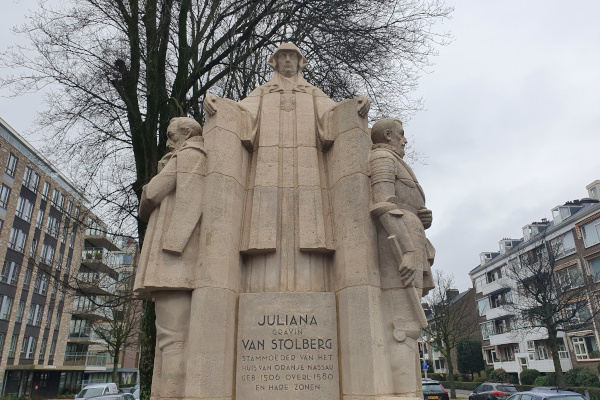
Juliana van Stolberg (1506-1580) was born and lived most of her life in Germany. At 14, she married Count Philip of Hanau-Munzenberg, and together they had five children. In 1529, Philip passed away, and she married Willem de Rijke. Together they had twelve children; seven daughters and five sons. Her son, William of Orange, led the successful Dutch rebellion against Spain for independence. His brothers also fought the battle, and some even died during the war.
Three hundred years after Juliana van Stolberg passed away, old letters revealed that she was not only the mother of five of the commanders of the Dutch rebellion but that she had a significant role as a consultant and financial supporter.
Inspired by her actions, Queen Wilhelmina named her first daughter and heir to the throne, Princess Juliana, in her honor.
On April 30th, 1927, on her 18th birthday, Princess Juliana laid the monument’s cornerstone; three years later, she unveiled it in the presence of Queen Wilhelmina and Queen Mother Emma on the Louise de Colignyplein in The Hague.
The sculptor Bon Ingen-Housz and the architect Dirk Roosenburg created it. They depicted Juliana van Stolberg in a tall stone heptagonal sculpture standing alongside her five sons – William I of Orange (Willem van Oranje), John VI “the Elder” (Jan van Nassau-Dillenburg), Louis of Nassau (Lodewijk van Nassau), Adolf (Adolf van Nassau), and Henry (Hendrik van Nassau).
Inscribed below Juliana is the following text:
“Juliana
Countess
van Stolberg
ancestress of the
House of Orange Nassau
b. 1506 deceased. 1580
and her sons”
On March 3rd, 1945, the British air force bombed the area causing the death of 500 people. The statue was barely scratched; in 1954, when the Bezuidenhout got rebuilt, the monument moved to the corner of Koningin Marielaan and Juliana van Stolberglaan, serving as a memorial to the 500 victims of the bombardment of Bezuidenhout.
A 10-minute walk will get you to the beautiful and spacious Haagse Bos park. Read more...

The Hague, Netherlands, Europe
In the center of the square on the avenue that bears her name, a bronze statue of the Queen of the Netherlands, Anna Pavlovna of Russia, is sitting on a bench, looking at and mingling with the visitors of the square while holding a decorated hand fan. The Russian sculptor Alexander Taratynov created it in 1999.
Anna Pavlovna of Russia (1795-1865) was born to the title Her Imperial Highness Grand Duchess Anna Pavlovna of Russia in the royal family of Russia. In 1816, Pavlovna married the Prince of Orange, who became King William II of the Netherlands in 1840. Together they had five children.
She had difficulty accepting the cultural differences between her home country and the Netherlands, specifically with the lack of distance between the royals and the commoners. As a princess and later as queen, Pavlovna learned the Dutch language, history, and culture; she focused on charity work, financing many orphanages and schools and establishing charity organizations.
In 1849, after the unexpected death of her husband, she retired from royal life and lived privately and a bit alone until she died in 1865.
Around the square are some lovely local restaurants. Panorama Mesdag museum and Noordeinde Palace are within walking distance to the east. Heading north from the statue will lead to the De Mesdag Collectie art museum and the Peace Palace. Read more...

