
A businesswoman and plantation owner in South Carolina, who cultivate indigo, making it the second cash crop export of the colony.
Born on the island of Antigua, a British colony in the Caribbean, where her family owned three sugarcane plantations. Eliza was the oldest daughter of a Colonel and had two brothers and a sister. At the time, most girls were trained to be wives and mothers and did not receive a formal education, but she was sent to a boarding school in England. There she studied subjects such as French and music, but her favorite was botany. When she was 15 years old, the family moved to South Carolina inheriting three tracts of land. The following year, her father had to return to Antigua to deal with the political conflict between England and Spain, so at 16, while her brothers were studying in England and her mother was ill, she took care of the family’s plantations, in South Carolina.
Her father sent her different types of seeds to try growing on the plantations, and Eliza planted hemp, ginger, alfalfa, and cotton. Her main goal was cultivating and improving the indigo plant’s strains, addressing the needs of the growing textile industry. She consulted with enslaved Africans who were experienced in growing indigo in the West Indies. After three years of failed attempts, she succeeded to grow and process indigo into a dye, and she shared her seeds and methods with other planters. In only three years, Indigo became the second cash crop of the colony, and by the Revolutionary War, it made up one-third of the exports from South Carolina, with a value of over $30 million of today’s terms.
At 22, Eliza married a widower plantation owner named Charles Pinckney, who was 23 years older than her. As a married woman, she channeled her focus to her husband and their four children. They moved to London for a few years before returning to South Carolina, where soon after her husband has died. Widowed at 36, she took care of their plantations, as well as her father’s estates. She also searched for a cure for cancer, the disease she died from at the age of 71. To this day, indigo is a symbol of South Carolina and the state’s official color. Read more...

An American actress, author, and inventor of the modern menstrual cup.
Leona W. Chalmers was born in the early 1900s. Little is known about her life, except the fact that she was an actress and the inventor of the first usable and available modern menstrual cup – a reusable device is used to collect menstrual flow. Though different designs appeared from 1867, none were usable, comfortable, nor safe. The model that Chalmers created and is the prototype of modern days cups is comfort, invisible, safe to use, as well as environmentally friendly.
In 1937 Chalmers patented and marketed her latex rubber menstrual cup. The cups didn’t do well in the market due to the mentality of the time, and the availability of disposable solutions, and due to the shortage in supplies of rubber in WWII, the cups’ production was put on hold. After the war, Chalmers continued her enterprise progressing menstrual cups but failed. She sold the rights of the design to Robert P. Oreck, who launched a new menstrual cup company in 1959, Tassette, Inc.
Still, Tassette also didn’t succeed in selling the new product to American women, mainly since they were used to the use of pads. Other reasons for the failure are the fact that it was hard to advertise a product related to a taboo subject, femininity, as well as the mindset to insert the device into the vagina.
After years out of the markets, the cups were relaunched at the beginning of the 21st century. Nowadays, menstrual cups are becoming more popular due to the growing awareness of environmental issues and the availability of hypoallergenic medical silicone. Chalmers didn’t get to see her vision pushing through, but she would definitely be proud to see her significant contribution to today’s menstrual solutions available. Read more...
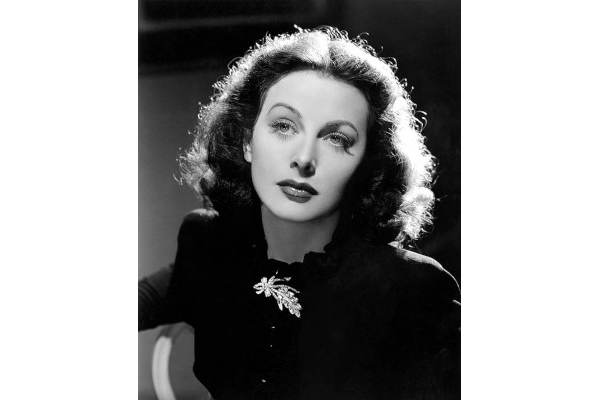
Film actress during Hollywood’s “Golden Age”, inventor, and the co-intervenor of the technology that will be the basis of modern days wireless communication systems.
Born as Hedwig Eva Maria Kiesler in Vienna, Austria-Hungary, the only child to parents of Jewish descent. Her mother converted to Catholicism, and Lamarr was raised as Christian. Her interest in technology started early on in her life. At age 5, she dismantled and reassembled her music box to understand how it works. Her interest in acting also developed from a young age, fascinated by theater and film, she took an acting class, and at 16 years old, she skipped school to work as a script girl at a film production company. Not long after, she got a role as an extra in a film, and at 17 landed her first speaking role.
Afterward, she moved to Berlin, and at 18, she was given the lead role in the controversial and sexually charged film, “Ecstasy”, performing in the nude in some scenes as well as during an orgasm. That same year, Lamarr married Friedrich Mandl – a 33 years old wealthy arms merchant. Mandl was a controlling husband who prevented Lamarr from pursuing her acting career, and after a few years, she fled home, escaping on a bike in the middle of the night.
At 23, Lamarr moved to London, where she met Louis B. Mayer of MGM. She turned down an offer of $125 a week, but booked a ticket to the same ship to America as he did, and managed to secure an offer of a $500 a week. Under the name Hedy Lamarr, Mayer promoted her as the “world’s most beautiful woman”, and in 1938, after the release of the movie “Algiers”, she became a worldwide sensation. Afterward, Lamarr was usually typecast in the roles of the glamorous seductress.
In 1950, Lamarr played the lead in the award-winning film “Samson and Delilah”, although she got critical acclaim for this role, her film career began to decline. In the following years, the movies she appeared in were failing at the box offices, and at the age of 44, she acted for the last time as her 30th movie was filmed.
In addition to her prosperous acting career, Lamarr was a self-taught inventor and had numerous inventions, including an upgraded traffic stoplight and a water-dissolve tablet that creates a soda beverage. During WW2, Lamarr and the composer George Antheil invented a technology for Secret Communications System, changing radio frequencies that prevent the enemies from decoding messages. Although it was granted by the US Patent and Trademark Office, it wasn’t implemented until 1962, when an updated version was designed. That invention is actually the basis of present days wireless communications, such as WiFi, GPS, and Bluetooth. Only in 1997, Lamarr was recognized for this invention, and became the first woman to receive the BULBIE™ Gnass Spirit of Achievement Award – “The Oscars of inventing.” Read more...

