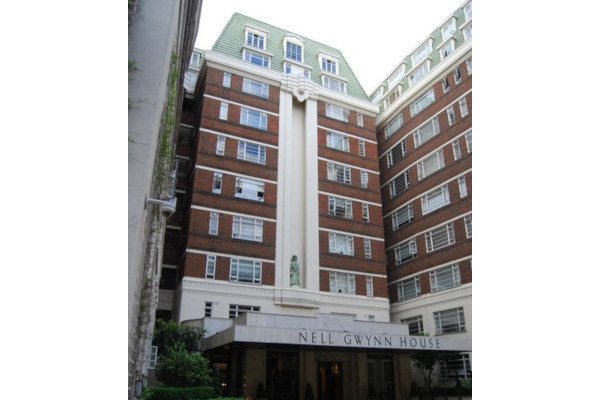
A statue of Nell Gwynn, one of Britain’s first actresses who became known as the mistress of King Charles II, stands above the entrance of a residential building named after her.
Eleanor Gwyn (1650-1687) was born in London to a low-class family and lived in the slum area of what is now known as Covent Garden. In 1660, Charles II regained the English throne; he removed the decade-long ban on theaters the Protectorate administration had dictated and the prohibition on female actresses. Soon after, Gwynn joined the Bridges Street Theatre, and by 1665 she became one of the most popular actresses of the time. When the theaters closed due to the Great Plague of London, she traveled with a theater company to entertain the King’s court in Oxford.
It was then when the King probably became acquainted with the young actress, but their relationship allegedly began a few years later, in 1668. She continued to perform at the King’s House, and her new status as the King’s mistress drew larger crowds, and several playwrights have written roles specifically for her. Though the King was married and had various companions, he declared Gwyn his favorite, they had two children, and the couple maintained their relationship throughout his life. On his deathbed in 1685, he swore his brother and successor, King James II, to take care of Gwyn, saying: “Let not poor Nelly starve.” She died two years later, at the age of 37.
Her statue stands in an alcove above the entrance of Nell Gwynn House in Sloane Avenue, Chelsea.
The Art Deco apartment building was designed in 1937 by George Kay Green. Though Sloane Avenue lies close to King’s road, King Charles II’s private road between his palaces in St James’ and Hampton Court, Gwyn herself had no relation to the location of Nell Gwynn House.
The statue depicts her in 17th-century aristocratic clothing, and a Cavalier King Charles spaniel rests at her feet. It is likely to be the only statue of a royal mistress in London.
The relationship between Gwynn and the King is portrayed in a bas-relief at the Venus fountain in Sloane Square, a short distance from Nell Gwynn House. Other nearby sites are Saatchi Gallery, the Chelsea flower showgrounds, and the National Army Museum.
This post is also available in:
 Español
This post is also available in:
Español


