
Ellis Island, NY, USA
A statue of Annie Moore, the first immigrant to the US to arrive at Ellis Island inspection station, is standing in the exhibitions in the Ellis Island National Museum of Immigration. The Irish artist Jeanne Rynhart created this statue and a statue of Moore with her two brothers, located at Cobh Heritage Centre in Cork, their departure port.
17 years old Moore arrived from Queenstown, Ireland, in New York with her two younger brothers on January 1st, 1892. They traveled for ten days on the Nevada steamship to join their parents, who immigrated three years earlier. Upon her arrival, a US officer welcomed her and gave her a 10 dollar coin. Over the years, Moore settled down in NYC, got married, and had 11 kids. She died in 1924.
The statue, a gift for the American people from the Irish-American Cultural Institute, was unveiled on May 18th, 1993, by the president of Ireland, Mary Robinson.
More things to do at Ellis Island National Museum of Immigration:
Enjoy the NYC skyline and the views of the Statue of Liberty.
Explore the Ellis Island National Museum of Immigration and its three floors of exhibits about the history and experience of the immigrants who came to build a new life in America; Check out your ancestry in the collection of arrival records.
Continue with the ferry to Liberty Island and travel to the grounds of the Statue of Liberty.
Ellis Island can only be accessed by a ferry (operated by Statue Cruises) from Battery Park in Manhattan or Liberty State Park in New Jersey. If you are visiting Liberty State Park, consider stopping 3 miles before it at the Mary McLeod Bethune Park and the Mary McLeod Bethune statue. Read more...

Prescott Valley, AZ, USA
A monument honoring the courageous pioneer women who settled, developed, and shaped Arizona. The 10 ft bronze statue is depicting a woman who just beheaded a rattlesnake in her garden. She is holding a headless snake in her right hand and a shovel in her left. She stands tall, strong, and determined, inspiring others to strive with determination to achieve their goals.
The statue’s commission was part of the Arizona Centennial celebration in 2012, led by Prescott Valley councilwoman Lora Lee Nye. The sculptress Deb Gessner created the statue from a painting of the artist Bob Boze Bell, who saw in this painting the image of his grandmothers.
On July 27th, 2013, the statue was unveiled and dedicated in a special ceremony in the Civic Center Park. Read more...
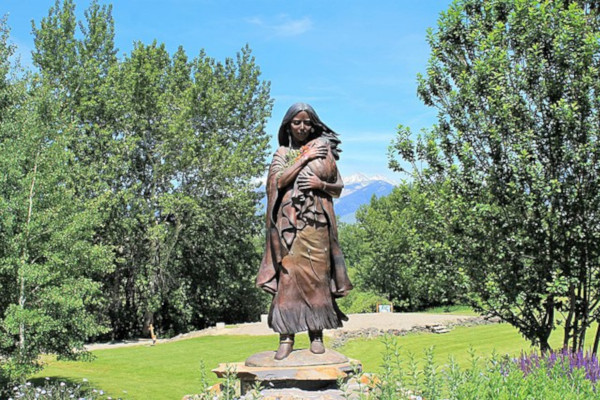
Salmon, ID, USA
Sacajawea statue is located at the 71 acres Sacajawea park in Salomon, Idaho, near her birthplace. Sacajawea was a Native American guide and interpreter on the Lewis and Clark Expedition to the Pacific Ocean. She accompanied the expedition with her two-month-old baby, and like this, she is depicted in this bronze statue. It was created in 2005 by the Idaho artist Agnes Vincen Talbot, famous for her Native American painting and sculptures.
At the park is the Sacajawea Interpretive, Cultural & Education Center, which is honoring Sacajawea’s life and educating about the rich culture and history of the Agaídika Shoshone-Bannock Tribes, who lived in the area. The Sacajawea Center hosts special events, occasional programs and provide information about other attractions in the area. Read more...

Yonkers, NY, USA
American Gold Star Mothers Memorial is a monument in downtown Yonkers, NY, dedicated to the Gold Star Mothers. They are the mothers who lost a son or a daughter during their military service in the US Armed Forces. The initiator for the Gold Star Mothers organization was Grace Darling Seibold, who lost her son in WW1. Seibold gathered a group of mothers who lost a child during the war, for mutual support and to assist hospitalized veterans. They named their group after the Gold Star that families hang on their window honoring the deceased veteran. The national organization was officially founded in 1928 and was chartered by the US Congress.
At the center of the memorial is a statue of a woman sitting on a chair. She is cradling the folded American flag that covered her child’s coffin in her hands, the same way she held her child as a baby. She is gazing at the sky, feeling “the mixture of pride and grief.” On her background are the American flag and the Gold Star Mothers’ flag. To her left, on a black granite stone, a sign reads:
“GOLD STAR MOTHERS
“They also serve who only stand and wait”
John Milton.”
Under the text are the symbols of six armed forces of the Department of Defense.
To her right, an image from a funeral is presented on a black granite stone.
The sculpture was created by the New Windsor artist Richard Masloski and was unveiled on October 15th, 2006, in downtown Yonkers, in front of the train station, where many mothers saw their child taking to the battle and never coming back.
More Interesting Anecdotes:
Gold Star Mother’s Day is observed in the US on September 30.
Several other statues and monuments are honoring the Gold Star Mothers across the US.
The organization has chapters in almost every state.
Each year, Gold Star Mother’s members contribute thousands of hours, dollars, and in-kind donations to Veterans Hospitals, Centers, and Cemeteries. Read more...

Phoenix, AZ, USA
This memorial is commemorating and honoring the first women settlers in Arizona. It was commissioned by the local chapter of the Daughters of Utah Pioneers. Though it was commission by a Mormon women’s group, it is dedicated to all pioneer women. Strong women who went through a long and hard journey and settled in the harsh desert.
The location at the Wesley Bolin Plaza, next to the Arizona state capital, was chosen by the governor itself in 1968. It is the only memorial dedicated to women at the Wesley Bolin Plaza, out of 30 memorials. Among the memorials in the plaza are – Ten Commandments Memorial, Rev. Doctor Martin Luther King Jr. Memorial, Navajo Codetalkers Memorial.
The plaque on the stone pedestal reads –
“Before 1875 hundreds of heroic women came to Arizona from the east and south. From this group came Arizona’s first schoolteachers and the publisher of the first newspaper.
In 1876 a group of pioneer women and their families came from the north, ferried their covered wagons across the Colorado River. With indomitable bravery and strength they helped make the desert blossom into a green oasis. Their descendants pioneered many settlements throughout Arizona. They displayed great courage and self-denial, which is the rich heritage of their posterity.” Read more...

Yonkers, NY, USA
A life-size bronze sculpture of the First Lady of Jazz, Ella Fitzgerald (1917-1996), depicts the famous signer standing with her arms open as if she is performing to the passerby of the Metro-North station in Yonkers.
Ella Fitzgerald was a jazz singer for 60 years, recording 200 albums, winning 14 Grammy awards and the Presidential Medal of Freedom. Since she was little, she loved jazz music, growing up facing many difficulties in a poor neighborhood in Yonkers, NY. Fitzgerald was 15 years old when her mother died. She moved to live with her aunt in Harlem, then in an orphanage, and back to Harlem. There she made her first performance and won first place at an amateur night at the Apollo theater. She was 17 years old.
Over the 60 years of her career, Fitzgerald performed solo, as well as with several bands, all over the world. She was also a civil rights activist, suffering herself from racial discrimination. She died in 1996, survived by a son.
A few months later, in October, the sculpture, created by the Yonkers-based artist, Vinnie Bagwell, was unveiled. It was her first commissioned statue, and she became the first African-American sculptress commissioned by a municipality (the City of Yonkers). Bagwell was the co-founder of Art on Main Street/Yonkers Inc and the initiator and the force behind the project The Enslaved Africans’ Rain Garden. Bagwell also created the statue of Sojourner Truth in the Highland’s Walkway Over the Hudson welcome center.
Read more...

Colts Neck, NJ, USA
A life-size bronze statue of Dorothy Day resides in front of St. Marys Parish in Colts Neck, New Jersey. It was the retirement gift to the church from Reverend Fr. William J. Bausch in 1996. The New Jersey artist Brian P. Hanlon, the founder of Hanlon Sculpture Studio, sculpted it.
Dorothy Day (1897–1980) was a social reformer, an anarchist, a journalist and editor, a pacifist, and the co-founder of the Catholic Worker Movement (still active today with more than 240 community centers). All her life, Day, advocated for justice and served the poor and homeless.
The statue is depicting Day sitting on a bench, leaning to her left side on a pack of books. Her left hand is holding a note while her right, a pen, she is gazing forward, wondering in her thoughts. The plaque to her right cites a review written by the mystic Catholic monk Thomas Merton to her book, Loaves, and Fishes:
“Every American Church should read Dorothy Day’s Loaves and Fishes because it exposes the comfortable myth that we have practically solved the “problem of poverty” in our affluent society. Poverty[…]is a greater problem than it ever was[…], but poverty, for Dorothy Day, is worse than a sociological problem. It is also a religious mystery, and that is what gives this book its extraordinary grace, and gentleness, and charm[…]This is a serious book about matters of life and death, not only for a few people, but for everybody.
Yet Dorothy Day never preaches, never pounds the table: she remarks quietly on the things she has seen, she points out their awful and well as their beautiful implications.
It is a great pity that there are not many more like Dorothy Day among the millions of American Catholics. There are never enough of such people, somehow, in the church. But without a few like her, one may well begin to wonder if we are still Christians. Her presence is in some ways a comfort, and in some ways a reproach. But I hope that those who read her book will be moved by it to serious thought and to some practical action: it is a credit to American Democracy and to American Catholicism.” Read more...

Butte, MT, USA
Our Lady of the Rockies is dedicated to all women and especially to mothers. It is a 90 ft tall (27 meters) statue, the fourth tallest statue in the US, sits on Saddle Rock atop Butte’s East Ridge, at an elevation of 8,510 ft. The tall white figure resembles the Virgin Mary, standing with her arms open, gazing at the mountain’s bottom.
The initiative to building the statue was of a local Butte resident, Bob O’Bill, who promised to build a 5 ft statue of Our Lady of Guadalupe if his wife, Joyce, would survive cancer. She did. And on December 29th, 1979, the work on the statue began. Money and material were donated, and all the work was done by volunteers from the community, who designed and created the statue.
On December 17th, 1985, a helicopter from the Nevada National Guard team lifted the statue in four sections to its current location. The statue is visible from the road at any time of the day, but if you want a closer look, guided tours during the summer season from Butte. Read more...

Las Vegas, NV, USA
A bronze statue of Helen Jane Stewart, who earned the title “The first lady of Las Vegas,” is located outside the entrance of the visitor center in the Old Las Vegas Mormon Fort State Historic Park.
Helen Jane Stewart arrived in Las Vegas Valley with her husband and three children in 1882. While pregnant with her fifth child, her husband got shot by a neighbor and died. She continued running her farm while expanding it by purchasing land, until she became the area’s largest landowner. In 1893, she was the first postmaster of Las Vegas. In 1902 she sold her ranch, and on her land, the city of Las Vegas was established.
Stewart remarried, moved to a new home in the growing community of Las Vegas, and had a key role in developing the city. She helped fund the city’s first public library and assisted in forming the Las Vegas School District. Read more...

Miami, FL, USA
A 10-foot-tall bronze statue of Julia Tuttle, who is considered the “Mother of Miami,” is standing in Bayfront Park, overlooking the seaport she envisioned at the end of the 19th century when South Florida was a swampland with few orange groves.
Tuttle relocated to Fort Dallas, Florida, from Cleveland, Ohio, in 1891. At that time, she was a widow with two kids and inherited her parents’ land. She purchased 640 acres on the north side of the Miami river and set it as her home. Seeing the potential to establish a city on the Miami River, she convinced Henry Flagler to extend his railroad to Fort Dallas (Miami). She offered him a free piece of her land and showed him that the area is a perfect destination to grow oranges after the Great Freeze of 1894-1895. On April 22nd, 1896, the Florida East Coast Railway’s train service came to the area, and a few months later, on July 28th, male residents voted to incorporate a new city, Miami. Ironically, Tuttle was not one of the voters since she was a woman.
The project to commemorate Tuttle started only in 1996 by the Miami Commission on the Status of Women. It took 14 years and joint efforts with the Miami-Dade County Commission for Women to raise funds and choose the artists Daub and Firmin.
The statue was unveiled on July 28th, 2010, the city’s 114th birthday, in a dedication ceremony honored with Tuttle family members. The statue is depicting Tuttle looking to the horizon, to the future, holding a basket of oranges in one hand and orange blossom on the other, the proof she gave Flagler. Her skirt is adorned with symbols of Miami’s history, the area’s first settlers, images of local flora and fauna, and the train that connected Miami to Florida.
Tuttle is the only woman who founded an American city.
Read more...

