

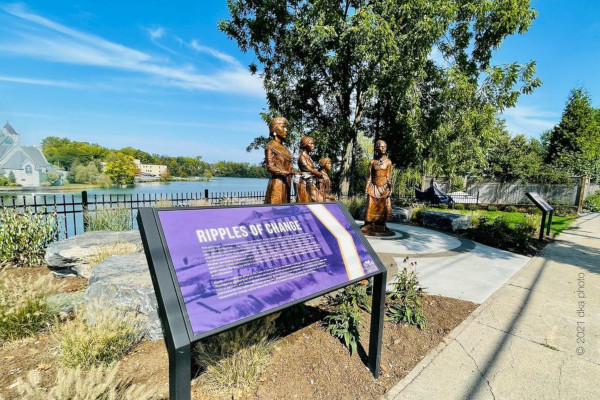
Ripples of Change is a monument of four statues of an Oneida leader and three suffragists from the Seneca and the Cayuga nations – Laura Cornelius Kellogg, Harriet Tubman, Martha Coffin Wright, and Sojourner Truth. It stands in Seneca Falls, the birthplace of the American Suffrage movement, overlooking the water and next to the statue When Anthony Met Stanton, which depicts three suffrage leaders – Susan B. Anthony, Elizabeth Cady Stanton and Amelia Bloomer.
As part of the centennial celebration of the 19th Amendment, the Women’s Suffrage Centennial Commission teamed up with the Town of Seneca Falls and the Seneca Falls Development Corp (SFDC) to create this statue. They chose the renowned sculptress Jane DeDecker and dedicated it on September 24th, 2021.
Each of the women stands in the center of a round pedestal, a beginning of a ripple. These ripples are the results of the women’s activism and leadership work that started a big change in the world.
The statues left to right:
Laura Cornelius Kellogg (1880-1947) was a Haudenosaunee leader, author, orator, activist, and founding member of the Society of American Indians. The suffrage movement got inspired by the traditions, structure, and hierarchy of the Haudenosaunee people, whose women were equal to the men. In her statue, Kellogg is wearing her formal, traditional clothes. Her hands are reaching forward, holding the Women’s Nomination Wampum Belt. The belt represents the Haudenosaunee sisterhood and the power of the clan Mothers. Next to the statue are a cluster of wild strawberries, a turtle that symbolizes that the monument stands on Cayuga Nation homeland, and a basket with the harvest of the three sisters: corn, beans, and squash.
Harriet Tubman (1820-1913) is known to all as the Black Moses.
A nickname that she got after escaping slavery and returned as a conductor in the underground railroad, risking herself to free hundreds of slaves. After setting them free, she used to help them to adjust to their new life, supporting them with money and safe accommodations.
Her statue depicts her standing with a cane, a determined and fearless look on her face. She is stepping forward leading the way.
Martha Coffin Wright (1806-1875) was an abolitionist and women’s rights activist. Like her older sister, the suffragist leader, Lucretia Coffin Mott, she was one of the organizers of the Seneca Falls convention, where the suffrage movement officially started. Her home in Auburn, New York, was a safe house on the Underground Railroad. In her statue, she is sitting and knitting. Next to her is a ship, which symbolizes Wright and her fellow abolitionist refusal to wear cotton, a product made by slaves. Their action led to the establishment of the Seneca Woolen Mill, which became in August 2020 the home of the National Women’s Hall of Fame.
Sojourner Truth (1797-1883) was a public speaker, abolitionist, and women’s rights activist.
She was a slave for the first 28 years of her life before escaping to her freedom with her infant daughter. English was her second language, and she did not know to read nor write, but in her forties, she followed a calling to become a preacher, changed her name to Sojourner Truth, and toured the country lecturing for equality. Her work broadened the notion of activism beyond the white, educated, middle-class women who primarily made up the suffrage movement.
In her statue, she is depicted at the moment before she is about to step up to the podium and give a speech, calling women to rise up.
The statues will move to their permanent location in Peoples Park, across from the National Women’s Hall of Fame, in 2023.
If you are interested to see the exact miniature replica of the statues, they stand at the Seneca Falls Heritage and Visitors Center.
This post is also available in:
 Español
This post is also available in:
Español


