
New York, NY, USA
The National Association of Women Artists, Inc (NAWA) is a nonprofit organization for women artists, the first of its kind in the US. Its mission is to promote awareness of women’s contribution to American art and culture created by women.
The NAWA Gallery, located at the heart of New York City, showcases changing exhibitions of its members’ works, presenting all genres of visual art, including painting, photography, sculpture, prints, installations, video art, and mixed media. A permanent collection of more than 200 artworks dating since the time the organization was founded is located at the Zimmerli Art Museum at Rutgers University in New Brunswick, New Jersey.
NAWA was founded in 1889 as the “Woman’s Art Club of New York” by five artists – Adele Frances Bedell, Anita C. Ashley, Grace Fitz-Randolph, Edith Mitchill Prellwitz, and Elizabeth S. Cheever. At the time, the art world was dominated by men, and this pioneering group of women bonded together to create a platform, opportunities, and recognition for professional women artists. Among NAWA’s first members were Gertrude Vanderbilt Whitney, Anna Hyatt Huntington, and among the 800 current members are Judy Chicago and many other talented artists. Read more...

Schenectady, NY, USA
A monument of Harriet Tubman and William Seward commemorates the friendship and partnership of the two abolitionists leaders and their role in the Underground Railroad.
Harriet Tubman was born into slavery, escaped, freed herself and became a conductor on the Underground Railroad. She returned to the south time after time to assist other slaves to escape to freedom. William Seward was a New York state senator, governor, and later served as secretary of state under President Lincoln. He and his wife Mary turned their house into a shelter for freedom seekers and provided a home for Tubman’s family. Seward even sold Tubman a land in Auburn, where she lived and operated for the rest of her life.
The life-size bronze statue was created by Dexter Benedict and unveiled on May 17th, 2019, in a small garden in front of the Schenectady County Public Library. It depicts Tubman walking forward, on her way back to the south, ready to rescue people from slavery. She is holding a stick in one hand and carries a tote bag on the other, inside there is a revolver ready for action. Seward is standing right behind her, with his hand on her back – a symbol for the support he has given her. The inscription plaque on the pedestal below reads “William Seward and Harriet Tubman, Leadership and Freedom, Diversity and Friendship,” as well as a quote by Lincoln: “By the People and for the People.” Read more...

Auburn, NY, USA
A 32-acre park dedicated to the life and legacy of Harriet Tubman – “the Moses of her people,” a conductor on the Underground Railroad that led more than 300 enslaved people to their freedom. Tubman, who herself was born into slavery, made this land heaven for her family and the needed people in her community.
The park, established on January 10th, 2017, includes three main sites:
The Harriet Tubman Residence – Tubman’s home from 1859, when she bought the land, until 1911.
The Harriet Tubman Home for the Aged – a home Tubman founded in 1908 for indigent and elderly African-Americans. Tubman herself lived in this home from 1911 until her death in 1913. The home was operated until 1920.
The Thompson Memorial African Methodist Episcopal Zion Church – Tubman’s worship place and where her funeral service was held.
Learn about Tubman’s life, her journey to freedom, and the ways she helped hundreds of people, both in slavery and in freedom. Stop by the Harriet Tubman Visitor Center to get a better understanding of Tubman’s impact on society, and pay a visit to her grave at Fort Hill Cemetery, located across the street of the park. Read more...

Royalton, NY, USA
Belva Lockwood Memorial and Garden is standing on Griswold Road in Royalton, honoring the women’s rights activist, one of the first female lawyers in the US, and the first female to officially run for President in 1884 and 1888.
At the memorial, there are two plaques. The first one states, “Belva Lockwood, first woman to argue before the supreme court, 1879. Presidential candidate, 1884 and 1888, for the national equal rights party.” The second plaque states, “Near this spot stood the log cabin birthplace of Belva A. Bennett.”
The idea for the memorial came in 1975. For the theme of “Women of the Year”, two active local Girl Scout leaders – Trudy Sworts and Doris March decided to commemorate Belva Lockwood near the place she was buried, and on November 23rd, 1975, with the help of the community and scout troops the plaque was unveiled. Read more...

Fayetteville, NY, USA
The interactive, engaging museum is unusual as the woman who lived here, Matilda Joslyn Gage. Gage was one of the suffragists movement leaders during the 19th century, as well as an activist for minority rights and abolitionist.
This museum was her house, in here, particularly in the Women’s Rights Room, she met with Susan B. Anthony and Elizabeth Cady Stanton, discussed movement next steps, co-wrote most of the NWSA documents, and co-edited the first three volumes of the six-volume “History of Woman Suffrage” (1881-1887).
In the Family Parlor Oz Room, she encouraged, contributed, and inspired her son-in-law Lyman Frank Baum to publish his Oz books.
The house was also part of the Underground Railroad, and hidden locations can be seen there. Each room has a piece of history to share. All the items in the exhibits are touchable. You may bring food and drinks, use the furniture or the piano, play in 19th-century toys, and even write Gage a message on the special wall. Read more...
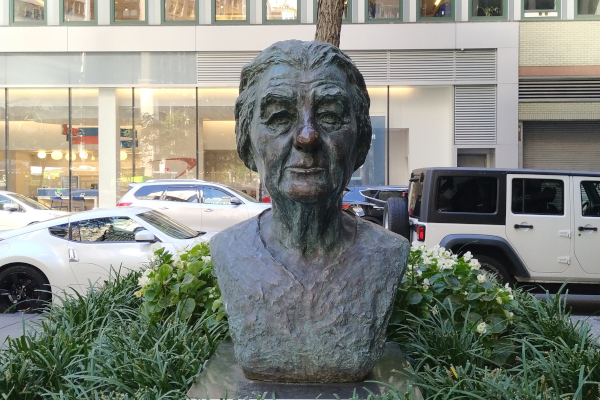
New York, NY, USA
A bronze statue of the 4th Prime Minister of Israel, the first and only female to serve in this position, and one of the few female head of states in the world. Meir, immigrated with her husband from the US to then Mandatory Palestine in 1921. She is considered as one of the founders of Israel and served in several positions in the administration and government before becoming the 4th Israeli Prime Minister. Among her nicknames were “The Iron Lady” and “The best man in the government.”
The statue is located on Golda Meir Square, a few minutes’ walk from Times Square. Created by Beatrice Goldfine and dedicated on October 3rd, 1984, commissioned by the Jewish Community Relations Council.
Till the beginning of the 21st century, the statue was standing on a six and a half feet granite pedestal, but for an unknown reason, the pedestal was removed. Since then, the statue is situated among low-lying greenery at the far corner of the square without any plaque or name. Read more...

Seneca Falls, NY, USA
‘When Anthony Met Stanton’ is a bronze sculpture commemorating a historic moment – the first time Susan B. Anthony and Elizabeth Cady Stanton met in May 1851. The event occurred after an anti-slavery meeting, which Anthony, Stanton, and Amelia Bloomer attended.
As presented in the sculpture, Bloomer is standing in the center, introducing between Anthony (on the left side) and Stanton (on the right side). Bloomer and Stanton are wearing their ‘reform dresses’ – a knee-length skirt over pantaloons, known as ‘bloomers’ after bloomer herself. Stanton is holding a book, as an expression of being the intellectual force behind the movement. This moment was the beginning of the friendship and cooperation of the two leaders of the women’s rights movement, which fought for voting and equal rights for women.
The sculptor was created by Professor A. E. ‘Ted’ Aub and dedicated in Seneca Falls on July 18, 1998, in honor of the 150th anniversary of the first women’s rights convention which held in Seneca Falls, New York on July 19–20th, 1848.
Several other landmarks in Seneca Falls celebrate the US women’s rights movement. Among them are the Ripples of Change Monument honoring Laura Cornelius Kellogg, Harriet Tubman, Martha Coffin Wright, and Sojourner Truth, the National Women’s Hall of Fame, Elizabeth Cady Stanton House, and the Women’s Rights National Historical Park.
All these places and more are featured on the Wander Women Project’s itinerary in Seneca Falls. Click here for all the details. Read more...

Rochester, NY, USA
At the park across the street from Susan B. Anthony House stands the statue of two of Rochester’s most acclaimed citizens – the suffragist leader Susan B. Anthony and the abolitionist leader, Frederick Douglass.
The bronze statue, created by Pepsy Kettavong, and erected in 2001, depicts the two civil rights activists in a middle of a conversation, between them there is a table set with a teapot, two cups, and a couple of books.
Anthony and Douglass shared more than a similar address; they were close friends who shared the same views about equality, abolitionism, and women’s rights, and both of them dedicated their lives to promote these ideas.
The statue encourages visitors to imagine what a conversation between those revolutionary icons would be like.
Read more...

Port Ewen, NY, USA
Many statues are commemorating Sojourner Truth, the orator, abolitionist, and women’s rights activist who escaped from slavery. While all of those depicts Truth as an older free woman, this bronze statue, created by the sculptress Trina Greene, portrays her as a young, enslaved girl, carrying jugs, barefoot on the way to her master’s tavern. The scars on her back emphasize her upbringing as a slave.
This Sojourner Truth Memorial was dedicated on September 21st, 2013, in the Town of Esopus, only a few miles from the area she grew up as a Slave.
Near the statue, lays a plaque describing Truth’s life story, from the first 32 years of her life as a slave in Ulster County to the civil rights symbol she became, reminding the visitors that the institution of slavery was not only in the south but all over the country, including New York State.
Another plaque honoring Truth is located at the corner of River Road and Route 9W, at Schryver’s tavern where Truth lived as a slave when she was 11 or 12 years old. Read more...

New York, NY, USA
Located on the fourth floor of the New-York Historical Society, the center is dedicated to telling the stories of women who had shaped the US throughout history and to women’s actions, lives, and legacies. The Center presents pioneer women from different classes, races, and sexuality from the Suffrage Movement to modern days activism.
The gallery, designed by the architect Eva Jiricna, features temporary and permanent exhibits, such as a collection of 132 Tiffany lamps, an interactive display of women who contributed to society like Madonna, Patti Smith, Molly Brant, and Elizabeth Cady Stanton, as well as the Billie Jean King archives, which includes some of the champion’s personal items.
The Center for Women’s History organizes public events, intimate conversations with experts, and the annual Diane and Adam E. Max Conference on Women’s History. Read more...

