
Washington, DC, USA
Located in the heart of Lincoln Park, Washington, DC, the Mary Mcleod Bethune bronze statue is facing the Emancipation Memorial/Freedman’s Memorial, the statue that presents Abraham Lincoln freeing an African-American slave. Bethune was a pioneer African-American educator and activist who fought for women and African-American equal rights.
The memorial, sculptured by Robert Berks, was unveiled on July 10, 1974, her 99th birthday. It shows Bethune handing two black children, a copy of her legacy. It is the first statue dedicated to an African-American in the US capital and was fund by the National Council of Negro Women, the organization Bethune founded in 1935.
Read more...
Washington, DC, USA
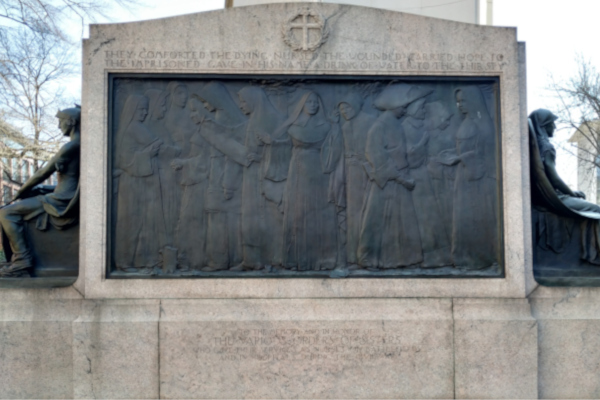
This memorial is dedicated to the hundreds of nuns who nursed the soldiers during the American Civil War, unveiled in September 1924.
The ten-year campaign for the memorial was initiated, led and fund-raised by Ellen Jolly, the president of the women’s auxiliary branch of the Ancient Order of Hibernians. Jolly was personally inspired by the stories about the nuns during the war and wanted to dedicate their contribution in the US capital.
The memorial, created by the artist Jerome Connor, presents 12 nuns on a bronze panel connected to a large granite slab. On both thin sides of the slab, there are two seated bronze female figures. Read more...

New Orleans, LA, USA
This gilded bronze statue is a copy of the sculpture made in 1899 in Paris by Emmanuel Fremiet (there are nine more replicas around the world), to honor Joan of Arc, the French heroine, a pioneer female warrior who had a significant role in the 100 Years’ War.
The statue was donated to the city in 1962 but erected only in 1972. It used to stand in International Trade Mart until in 1999 the property was bought, and it was moved to its current and far more proper location, near the French Market.
Another statue of Joan of Arc in New Orleans is located in the St. Louis Cathedral, as she was canonized as a Roman Catholic saint.
An annual parade and festival are taking place in the city on Joan of Arc’s birthday, January 6th. The events are organized by the Krewe de Jeanne D’Arc. For more information on the parade click here. Read more...

Washington, DC, USA
A bronze statue of Eleanor Roosevelt is standing behind UN emblem honoring her as the first US delegate to the UN. Eleanor Roosevelt served as the 32nd First Lady, from 1933 till 1945, during her husband presidency term. She was a politically active First Lady, an activist, and a mother of six.
The statue is part of the Franklin Delano Roosevelt (FDR) Memorial in Washington, DC, which was dedicated on May 2nd, 1997. It is the only memorial dedicated to a First Lady in the national mall and a presidential memorial. It was created by the sculptor Neil Estern who also produced the nearby seated figure of Franklin Delano Roosevelt with his dog. Read more...

New Orleans, LA, USA
The Sophie B Wright statue is a monument honoring the life and contribution of Sophie B Wright – a feminist, educator, healthcare promoter, and advocate for prison reform.
The statue, sculpted by Enrique Alférez, and dedicated in 1988, depicts Wright sitting in an unusual position, looking sideways while holding a book in her hand. Wright’s facial expression portrays her fearless attitude, and her will to educate her community’s children.
It is located at a park that was named after her upon her death in 1912. The park is near the former site of the Home Institute, a day and boarding school for girls which Wright operated.
In July 2020, as part of the global George Floyd Protests, the statue was vandalized with “BLM” (Black Lives Matter) painted all over it in red spray, and a white hood was put on its head, to object of Wright’s support in segregation, and her membership in the Daughters of the Confederacy.
Read more...

New Orleans, LA, USA
In 1884, this memorial was dedicated to commemorate and honor Margaret Haughery, or as she was widely known, “Margaret of New Orleans,” “The Bread Woman of New Orleans,” and “Mother of Orphans.” It is one of the first memorials in the USA dedicated to a woman, created by Alexander Doyle, unveiled two years after Haughery’s death.
Arriving in New Orleans in 1835 with her husband, with no money and soon before giving birth to a new baby, she was left alone a few months later. As an orphan herself, and now as a widow, Haughery dedicated her life and the money she earned, to support orphans and widows in New Orleans. At first, the money she donated originated from her wages, ironing in a laundry, and later from the businesses she built on her own, a dairy and bakery.
While developing her business, she supported the building of several orphanages in the city, donated money produce from her business on a daily basis. When she died, she left all her assets besides the bakery to charities. After she passed away, the people of New Orleans gathered to build a statue to honor her contribution to the community. Read more...

New Orleans, LA, USA
Ruby Bridges Statue was dedicated on November 14th, 2014, in the courtyard of William Frantz Elementary School. Fifty-four years before, when Bridges was six years old, she was escorted to the school by federal marshals, for her personal security, as the first African-American girl in New Orleans to enroll in an all-white school.
This was a key event in the African-Americans struggle against school segregation in the south, which happened a few years after the Supreme Court ruled that school segregation was unconstitutional in the famous Brown v. Board of Education case.
During her first year at school, she was taught alone by only one teacher, Barbara Henry. It took a while till the boycott of the white parents was settled, and Bridges continued to study in desegregated schools till she graduated from high school. When she grew up, she continued her activism work and, in 1999, founded the Ruby Bridges Foundation to eliminate racism, segregation, and equal education to all.
The William Frantz Elementary School was closed in 2008 and is now the home to the Akili Academy of New Orleans. Since the statue located inside the school courtyard, need to coordinate the visit with the school, at 504-355-4172.
At the front door of the school building, there is a marker commemorating the day Bridges entered the school for the first time and made history. The area around the school is residential without tourist attractions. A mile and a half from it, there is a beautiful open street art area between 2239 St Claude Ave and 1101 Elysian Fields Ave. The French Quarter is 2.5 miles from the school.
Bridges is also depicted in “The Remember Them: Champions for Humanity Monument” in downtown Oakland, California, and in a statue at the University of Missouri, Kansas City.
Dive deeper into the inspiring story of Ruby Bridges with our fun and engaging printable worksheet!
Available now on Etsy and Teachers Pay Teachers.
Join a guided-tour to learn more about the pioneer women of New Orleans:
The Bad Broads Tour of New Orleans
New Orleans’ Influential Women Private Walking Tour
More statues of iconic African-American women:
Nancy Randolph Davis
Fannie Lou Hamer
Alice Allison Dunnigan
Harriet Tubman Read more...

Boston, MA, USA
The Boston Women’s Memorial is a monument dedicated to three women who challenged norms and shaped US history: Abigail Adams, the wife and advisor of President John Adams, Lucy Stone, the founder of the ‘Woman’s Journal,’ and Phillis Wheatley, the enslaved poet.
As their real-life personas, the three sculptures, made by Meredith Bergmann, are redefining conventions. Instead of standing up high on their pedestals, they use it as a prop, encouraging people to interact with them. Each statue symbolizes the life story of the woman it represents and her influence on society via the written word. The memorial was dedicated on October 25th, 2003. Read more...

New Orleans, LA, USA
Mahalia Jackson Statue is located in her home town, New Orleans, next to a theater commemorating her memory, the Mahalia Jackson Theater for the Performing Arts, at Louis Armstrong Park.
Jackson was born in 1911, singing from a young age, but only years after moving to Chicago, rose to fame as the “Queen of Gospel”, introducing the genre to the world. Besides singing, she was an activist in the Civil Rights Movement.
The statue was made by Elizabeth Catlett, an African-American graphic artist and sculptor (who also made the Louis Armstrong statue in the park), and which she dedicated to the city in April 2010. Read more...

New York, NY, USA
The Harriet Tubman memorial in the heart of Harlem was the first statue in the city that honored an African–American woman when it was unveiled on November 13th, 2008.
Harriet Tubman (1822-1913) lived in slavery on the Eastern Shore of Maryland for almost thirty years before she escaped to Philadelphia and became free. She decided to dedicate her life to freeing others, so she became a conductor on the Underground Railroad, returning to Maryland time after time to lead enslaved people north to freedom. She joined the Union Army in the civil war and guided hundreds of enslaved to a safe place. When the war ended, Tubman settled in Auburn, New York, and promoted equal rights and suffrage. There, she established the Harriet Tubman Home for the Aged and spent her last years there.
The artist Alison Saar sculpted the 13-foot-high bronze statue depicting Tubman in motion while the roots of slavery are attached to her back, trying to pull her back. Faces and items of the enslaved people she helped to escape are inscribed to her skirt, and she moves forward as if she is the train that carries them.
Around the base of the statue are tiles representing moments from Tubman’s life and traditional African-American quilting symbols. Native New York and Maryland plants were planted around the monument, representing the landscape of the Underground Railroad Read more...

