
London, England, UK
The Women of World War II is the first national memorial in the UK to honor the nearly seven million women who contributed to the war effort during WW2. By 1943, nine out of 10 British women aged 20-30 joined the armed forces and the civilian services. About 640,000 women volunteered in various military divisions, such as the Women’s Royal Naval Service and the Women’s Auxiliary Air Force; others worked as mechanics, engineers, and fire engine drivers, while hundreds of thousands took the vacant places in factories and workshops. As the war ended, women were forced to leave their positions and return to their domestic roles.
The initiative for the memorial was raised in 1997 by Major David Mcnally Robertson; together with former gunners Mildred Veal and Edna Storr, they founded a charitable trust for the cause. Soon after, Princess Royal Ann, Dame Vera Margaret Lynn, and Betty Boothroyd, Baroness Boothroyd, became patrons of the fund. The Baroness even raised some of the funding on an episode of Who Wants To Be A Millionaire? A sum of £1 million was contributed by various organizations, with over £300,000 raised by the public.
The monument was unveiled on July 9th, 2005, by Queen Elizabeth II as part of the 60th anniversary of the end of WW2. The dedication ceremony included a flyover of five military helicopters flown by all-female crews.
The 22 feet high, 16 feet long, and six feet wide bronze rectangle contains 17 sets of clothing, uniforms, and helmets hung around it, including police overall, a nursing cape, a welding mask, and uniforms worn by the Women’s Land Army. Those sets symbolize the hundreds of different jobs women undertook during the war. The gold lettering on the sides is a replica of the font used on wartime ration books.
Sculptor John Mills was inspired by a 1940s photograph of a cloakroom at a dance hall and designed the monument as a reminder that after the war, women were forced to hang up their uniforms to make a place for the men who came back.
The Monument to the Women of World War II stands at Whitehall St., which is famous for the many memorials and monuments. It is also close to other statues and historical places. Among them are the Fourth Plinth and Nelson’s Column in Trafalgar Square, the Edith Cavell Memorial at St. Martin’s Place, the Florence Nightingale Statue at Waterloo Place, Schomberg House where the 18th-century artist Maria Cosway lived, the memorial plaques of Nell Gwynne and Ada Lovelace in James’s Square, the Mother and Child statue in St James’s Square Garden, and St James’s Church. It is also only a few minutes walk from the Big Ben and Parliament Square, where Millicent Fawcett Statue stands. Read more...

Statue, Gettysburg, PA
The Women’s Memorial in Gettysburg, also known as the Civil War Women’s Memorial, is dedicated to all the women of Gettysburg who served and supported the war effort. The bronze statue depicts Gettysburg’s hero, Elizabeth Thorn, who was the wife of the caretaker of Evergreen Cemetery. During the Gettysburg Battle, her husband, Peter, was away, fighting for the Union Army; she was six months pregnant and took over his responsibilities as the cemetery caretaker and cared for their three sons and elderly parents. When the battle was over, they returned to their home at the cemetery gatehouse, discovering that their possessions were destroyed and that they must bury more than 100 soldiers who lost their lives on the battlefield. In several days, she and her father buried more than 105 soldiers in the heat of July.
The couple, who was the first caretakers of the cemetery, left in 1874.
They died in 1907 and were buried at Evergreen Cemetery, approximately 200 yards from the gatehouse.
The 7-foot statue depicts Thorn with a baby bump; she is on a break from digging the graves, and her shovel rests on her.
The New York artist Ron Tunison created the statue, and it was dedicated on November 16th, 2002. Read more...

Richmond, CA, USA
A monument at the Rosie the Riveter/WWII Home Front National Historical Park commemorating the “Rosies” – the women laborers who worked in the shipyards during World War II. This is the first national memorial honoring the contribution of women in the home front.
The monument, designed by visual artist Susan Schwartzenberg and landscape architect/environmental sculptor Cheryl Barton, is a ship’s keel length walkway inscribed with the home front timeline and quotations of female workers. A sculpture, in the form of a ship being built, displaying letters, photographs, and other memorabilia of women laborers from all over the country. It was dedicated in October 2000.
Learn about the women workforce during these crucial times and discover the challenges they faced, including hazardous working conditions, shortages of childcare, food rationing, and gender discrimination.
Rosie the Riveter Memorial established due to the campaign of Chairwoman Donna Powers. She was inspired by the stories she heard about women’s labor during WW2. With the help of the historian Donna Graves, the monument, and afterward the park itself, became the first National Historical Park to memorialize the efforts of the women workforce of the home front. Read more...
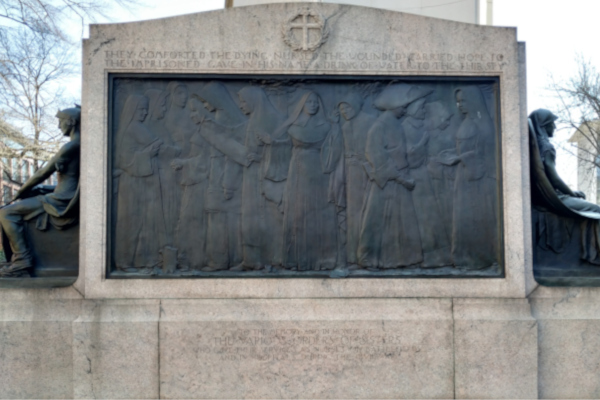
Washington, DC, USA
This memorial is dedicated to the hundreds of nuns who nursed the soldiers during the American Civil War, unveiled in September 1924.
The ten-year campaign for the memorial was initiated, led and fund-raised by Ellen Jolly, the president of the women’s auxiliary branch of the Ancient Order of Hibernians. Jolly was personally inspired by the stories about the nuns during the war and wanted to dedicate their contribution in the US capital.
The memorial, created by the artist Jerome Connor, presents 12 nuns on a bronze panel connected to a large granite slab. On both thin sides of the slab, there are two seated bronze female figures. Read more...

Washington, DC, USA
The Clara Barton Missing Soldiers Office was the home of the founder of the American Red Cross during and after the Civil War, where she stored supplies needed for her work as a nurse during the war, and here she established and operated the “Office of Correspondence with the Friends of the Missing Men of the United States Army.”
The mission of the office was to find missing soldiers that haven’t come back from the war. Barton and her staff responded to more than 63,000 letters, and due to their efforts, they were able to identify more than 22,000 missing men.
For 130 years Clara Barton’s Missing Soldiers Office was forgotten. In 1996, Richard Lyons of the General Services Administration rediscovered the place when the building was about to be demolished. Afterward, the site has been restored, and the museum was established as part of the National Museum of Civil War Medicine.
Visit the restored rooms where Barton lived and worked, and explore items related to Barton’s life, such as handwritten letters, tin advertisement signs and a map from the Civil War era with marked hospitals and forts in Washington, D.C.
You can also enjoy special exhibits and events, such as ‘The Washington Navy Yard and the Civil War’, ‘Clara Barton at Andersonville’, and ‘War on Our Doorsteps.’ Read more...

