
New York City, NY, USA
One of the most recognizable landmarks of the US, and particularly of NYC, “The Statue of Liberty Enlightening the World,” was given to the American people by the French people as a commemoration of the lasting friendship between the two nations.
The initiative was suggested in 1865, in the purpose of celebrating the creation of a viable democracy after the Union’s triumph in the American Civil War. Still, because of a lack of funds, both in France and in the US, the work on the statue began only 10 years later. The French sculptor Frederic-Auguste Bartholdi designed the statue and manually created it out of sheets of hammered copper, while Alexandre-Gustave Eiffel, the man who has the Eiffel Tower named after, designed the steel framework. When the statue was completed, it was disassembled and shipped from France to Bedloe’s Island, known today as Liberty Island (since 1956). After four months of reassembling, it was mounted on the pedestal, designed by the architect Richard Morris Hunt.
Standing 151 feet 1 inch high and weighing 225 tons, Lady Liberty is a Libertas figure – the Roman goddess and personification of liberty. In her right hand, she holds a torch high above her head, to light the way to those arriving at the free country, in her left hand she carries a tablet inscribed with the Roman numerals JULY IV MDCCLXXVI – the date of the US Declaration of Independence. A crown is laid on her head, with seven rays, representing the promise for freedom for each one of the seven continents. Wearing sandals, she is walking forward, stepping on the broken shackles of oppression, commemorating the abolition of slavery. On the pedestal she is standing on, there is a bronze plaque inscribed with the sonnet, “The New Colossus,” written by Emma Lazarus. There is no official information about the woman who was the model for the statue’s face, some sources claim it was based on Bartholdi’s mother, while others believe it’s a depiction of Ruth Singer, the French wife of the American businessman Isaac Singer.
The dedication ceremony on October 28th, 1886, was a private event, and the public was not allowed to participate. Out of all the reserved seats, only two women were granted access. During the ceremony, a group of suffragists rented a boat and came by the island, making speeches about the hypocrisy of the statue, a token of freedom, when the women of America cannot vote. Soon after its dedication, the statue became a welcome sign for the thousands of immigrants who passed by every day, on their way to the land of the free and the home for the brave. The statue was declared a National Monument in 1924.
More Interesting Anecdotes:
Bartholdi’s first idea for the statue was meant to be placed at the Suez Canal in Egypt, where it was supposed to serve as a huge lighthouse called “Egypt Carrying the Light to Asia.” It was rejected due to the high expenses.
The dedication of the statue was initially planned to held in 1876 for the centennial of the Declaration of Independence.
Emma Lazarus donated the poem as part of a fundraising contest for the pedestal.
During the restoration of the statue in 1986, the torch was covered with thin sheets of 24k gold.
There are 154 steps from the bottom of the pedestal to the head of the Statue.
The green color of the statue is the result of natural weathering of the copper.
The site of the statue is on the UNESCO’s World Heritage List since 1984.
There are replicas of the statue all over the world, including Paris, where a smaller version of the statue is facing west, toward its sister in New York City.
On an adjacent island to the Statue of Liberty, you will find the Ellis Island National Museum of Immigration. In the past, Ellis Island served as the inspection station for new immigrants to America. The museum showcases three floors of exhibits about the history and ordeals of the immigrants and archives the collection of arrival records.
Be sure to check out the statue of Annie Moore, who arrived on Ellis Island as the first immigrant to the country.
How to see the Statue of Liberty?
The statue can be seen from viewpoints in Battery park as well as on a ride with the Staten Island Ferry (going back and forth from every 30 minutes or every 15 minutes during rush hour during weekdays). If you wish to get a closer look, you can take the ferry to Liberty Island. To climb to the Pedestal (10 stories high) and/or the Crown (20 stories high), you will need to reserve a ticket. For more information, check out NPS website. Read more...

New York, NY, USA
A fountain memorial is commemorating social worker and progressive reform leader Josephine Shaw Lowell (1843-1905). Became a civil war widow at 21, Lowell co-founds the NYC consumers league – an organization aimed to improve working conditions and wages of working women. She also founded the Charity Organization Society and was the first woman to be a member of the NYC Board of charities.
Dedicated on May 21st, 1912, the fountain is the first monument in NYC to honor a woman. Designed by Architect Charles A. Platt, the fountain is made of granite and bronze and composed of a 13-foot upper basin supported by a 32-foot pedestal. First, it was installed on the east side of Bryant Park, and in 1936, it was relocated to the west side, on the other side of the statue of Gertrude Stein. A small sign on the ground, almost unnoticeable, states, “This fountain commemorates the strong and beautiful character of Josephine Shaw Lowell 1943-1905.”
Read more...

New York City, NY, USA
This marble bench and drinking fountain were dedicated on May 7th, 1910, to celebrate the 25th anniversary of the Woman’s Health Protective Association.
During the 19th century, the streets of NYC were filled with dirt, manure, garbage, and factory waste. Eleven ambitious women recognized the health problems of living in these surroundings, and in 1884 they established the organization. They investigated sanitation issues, such as street cleaning, school hygiene, sewer draining, and clean water supply. Their tireless efforts led to the passage of several sanitary laws, which remain to this day. In the next thirteen years, the association branched out to other cities across the US.
The memorial was created by Bruno Louis Zimm. The marble stele depicts two women holding a lamp, representing the organization’s mission to shed light on public health concerns. The names of the WHPA members are inscribed on the benches beside the stele. Read more...

New York, NY, USA
Located in James Michael Levin Playground at Central Park, the Loeb Memorial Fountain is honoring the journalist and social worker Sophie Irene Loeb, known as the godmother of American children.
Divorced at 35, Loeb moved to NYC and started to write for the Evening World. As the oldest of six children in a family of migrants, Loeb helped her widow mother to support the family. Familiar with financial struggles, she mainly wrote about social subjects, such as welfare for widowers, community centers and playgrounds for children, school lunches funding, housing reforms, installation of public baths, and fireproofing movie theaters. She founded and served as the president of the Child Welfare Board of NYC, as well as of the Child Welfare Committee of America.
The fountain was unveiled on October 3rd, 1936, and created by Frederick G.R. Roth. Inspired by Lewis Carroll’s Alice in Wonderland, the granite pediment depicts various characters from the book, including Alice, the queen and king of hearts, the hatter, the white rabbit, and the Cheshire cat. The base of the fountain is engraved with Loeb’s quotations. Read more...

New York, NY, USA
The National Association of Women Artists, Inc (NAWA) is a nonprofit organization for women artists, the first of its kind in the US. Its mission is to promote awareness of women’s contribution to American art and culture created by women.
The NAWA Gallery, located at the heart of New York City, showcases changing exhibitions of its members’ works, presenting all genres of visual art, including painting, photography, sculpture, prints, installations, video art, and mixed media. A permanent collection of more than 200 artworks dating since the time the organization was founded is located at the Zimmerli Art Museum at Rutgers University in New Brunswick, New Jersey.
NAWA was founded in 1889 as the “Woman’s Art Club of New York” by five artists – Adele Frances Bedell, Anita C. Ashley, Grace Fitz-Randolph, Edith Mitchill Prellwitz, and Elizabeth S. Cheever. At the time, the art world was dominated by men, and this pioneering group of women bonded together to create a platform, opportunities, and recognition for professional women artists. Among NAWA’s first members were Gertrude Vanderbilt Whitney, Anna Hyatt Huntington, and among the 800 current members are Judy Chicago and many other talented artists. Read more...
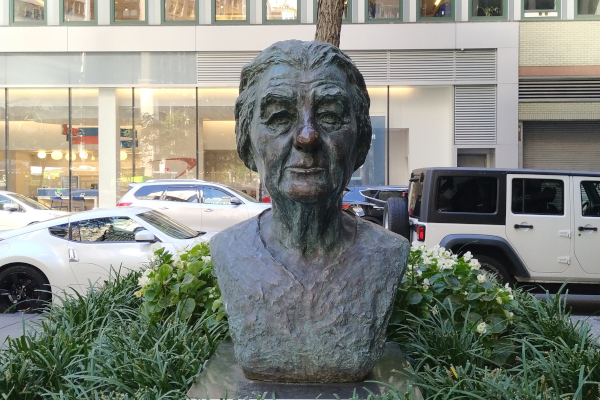
New York, NY, USA
A bronze statue of the 4th Prime Minister of Israel, the first and only female to serve in this position, and one of the few female head of states in the world. Meir, immigrated with her husband from the US to then Mandatory Palestine in 1921. She is considered as one of the founders of Israel and served in several positions in the administration and government before becoming the 4th Israeli Prime Minister. Among her nicknames were “The Iron Lady” and “The best man in the government.”
The statue is located on Golda Meir Square, a few minutes’ walk from Times Square. Created by Beatrice Goldfine and dedicated on October 3rd, 1984, commissioned by the Jewish Community Relations Council.
Till the beginning of the 21st century, the statue was standing on a six and a half feet granite pedestal, but for an unknown reason, the pedestal was removed. Since then, the statue is situated among low-lying greenery at the far corner of the square without any plaque or name. Read more...

New York, NY, USA
Located on the fourth floor of the New-York Historical Society, the center is dedicated to telling the stories of women who had shaped the US throughout history and to women’s actions, lives, and legacies. The Center presents pioneer women from different classes, races, and sexuality from the Suffrage Movement to modern days activism.
The gallery, designed by the architect Eva Jiricna, features temporary and permanent exhibits, such as a collection of 132 Tiffany lamps, an interactive display of women who contributed to society like Madonna, Patti Smith, Molly Brant, and Elizabeth Cady Stanton, as well as the Billie Jean King archives, which includes some of the champion’s personal items.
The Center for Women’s History organizes public events, intimate conversations with experts, and the annual Diane and Adam E. Max Conference on Women’s History. Read more...

New York City, NY, USA
The Leslie-Lohman Museum of Gay and Lesbian Art is the first and currently the only museum in the world dedicated to artwork associated with the various elements of the LGBTQ experience.
Founded in 1969 by The Leslie-Lohman Gay Art Foundation as a commercial art gallery. During the AIDS pandemic of the 1980s, the collection grew as the founders, Charles Leslie and Fritz Lohman Leslie, salvaged works made by dying artists that were meant to be destroyed by their families.
In 1987 the foundation application to be recognized as a nonprofit organization was declined because the word “Gay” was in the title. It took a few years before it was granted the nonprofit status.
This visual art museum collects and displays artworks related to LGBTQ people and issues, or created by LGBTQ artists, such as David Hockney, Catherine Opie, and Jean Cocteau.
The museum houses a collection of more than 30,000 art objects, including drawings, paintings, sculptures, prints, and photography. In addition to the permanent and rotating exhibits, the museum hosts special events like lectures, performances, and pool parties. Read more...

New York, NY, USA
Joan of Arc bronze sculpture in Riverside Park is a one and a fourth times life-size statue of the 15th-century French heroine and martyr who commanded and led an army to victory during the Hundred Years War. Upon its dedication on December 6th, 1915, it was the first monument in NYC commemorating a non-fictional woman.
The American sculptress Anna Vaughn Hyatt Huntington created this sculpture after conducting thorough research to create an original statue of the heroine. The sculpture depicts Joan of Arc as a spiritual figure, holding her sword up to God praying for guidance while riding on a warhorse.
A granite base created by John Van Pelt incorporates stones from the cathedral in Rheims where Joan of Arc stood during King Charles VII’s coronation and limestones from the Tower of Rouen, where she was imprisoned for heresy and witchcraft before she was burned to death.
Huntington’s plaster model was cast by the Gorham Manufacturing Company in Providence, Rhode Island.
Over thirty years, four replicas were created from this statue and stand in Blois, France, Gloucester, Massachusetts, San Francisco, California, and Québec City. Read more...

New York, NY, USA
A statue honoring Gertrude Stein – a poet, author, playwright, and art collector.
The bronze sculpture on display at Bryant Park, dedicated on November 5th, 1992, is based on a terra-cotta model the sculptor Jo Davidson, created at his studio in Paris in 1920. He chose to depict her as a modern Buddha. Stein was delighted and composing prose about it. This model is on display at the National Portrait Gallery in Washington, DC.
This is one of the five sculptures of historic women in the city. The statue’s location, neighboring the New York Public Library, indicates the significant contribution Stein has had on literature. Read more...

