
Bala, Ontario, Canada
A visit to the Bala’s Museum will take you back to Canada in the 1920s. The museum focuses on the famous Canadian author Lucy Maud Montgomery and her books but also showcases historical artifacts from the Muskoka region.
The story behind the establishment of the museum started in 1990 when Linda and Jack Hutton honeymooned on Prince Eduard Island following Linda’s wish to visit the place where Lucy Maud Montgomery wrote Anne of Green Gables. There, they learned that Lucy Maud Montgomery spent her two-week holiday in Bala during the summer of 1922. Not only did Montgomery loved it, but she was also inspired to set there the only novel she set outside Prince Eduard Island, The Blue Castle in Muskoka. When they discovered that the Tree Lawn Tourist Home, where Montgomery ate her meals during her vacation, stands for sale, they bought it. After extensive restoration, on July 24th, 1992, the museum was opened.
Lucy Maud Montgomery (1874-1942) set almost all of her books at Prince Eduard Island, where she grew up and lived most of her life. Her first novel Anne of Green Gables (published in 1908), became an immediate bestseller and brought her worldwide fame. It was adapted to any possible media type and translated into more than 36 languages.
During her lifetime, she became one of the most popular authors in the world and published 20 novels, 500 poems, 530 short stories, and 30 essays.
Montgomery’s books have created a travel industry, bringing local and foreign tourists to follow her landmarks across Canada, visiting the sets of the books and other locations related to her in Prince Eduard Island and Ontario, such as this museum.
The Bala’s Museum showcases vintage furniture from the 1920s, unique copies of Montgomery’s books from different editions and different languages, dioramas from the novel Anne of Green Gables, the world’s biggest Anne of Green Gables dollhouse, and personal items of Montgomery, including a silver tea set gifted for her 1911 wedding, her correspondence basket, and excerpts from her diary during her visit to Bala.
Kids can explore the museum wearing costumes, play in Anne’s school room, enjoy Anne’s tea party with Diana, and host Anne of Green Gable’s birthday party.
While at the museum, make sure not to miss a visit to the gift shop that carries a vast collection of Anne’s souvenirs and Montgomery’s books. Read more...

Athalmer, British Columbia, Canada
A bronze statue of Charlotte Small with her husband and partner David Thompson stands in the heart of Pothole Park.
The concrete base of the sculpture has four bronze reliefs depicting the following events:
“Winter 1787 with the Peigans”
“Columbia Discovered …1807”
“At the mouth of the Columbia…July 1811”
“Crossing Athabasca Pass…winter 1811”
Another plaque states:
“This is a millennium project of the Windermere District Historical Society.
It has been achieved through the donations of many sponsors and many pioneer families. Unveiled July 18, 2003.”
Small was born in 1799 to a Cree mother and Scottish father, who was a North West Company partner. He returned to Europe, leaving Small and her siblings with their mother. On June 10, 1799, at 13, she left home to marry David Thompson, a twenty-nine-year-old fur trader. Fluent in English, French, and Cree, a skilled hunter who knew how to survive in harsh conditions and find her way in the wild, Small became Thompson’s right hand and joined him in the expeditions while bearing and raising their five children.
After Thompson retired from fur trading, the family relocated to the Montréal region. They renewed their marriage vows by a minister and welcomed eight more children into their family. They passed away within three months of each other in 1857 in Longueuil, Quebec.
Small was one of many Aboriginal women who married European fur traders and contributed their skills, knowledge of the language, and culture. While Small and Thompson stayed together for 58 years, many other wives were abandoned by their husbands, who returned to Europe when their mission ended.
Thompson got the acknowledgment of North America’s greatest geographer for his exploration and mapping of Canada. Charlotte’s skills and abilities allowed him to accomplish that. But she never received the same recognition as him.
The Alberta sculptor Rich Roenisch insisted on including the statue of Small when he was commissioned to create Thompson’s statue. It was the first statue in Canada that commemorates her and honors her contribution. Read more...

Prince George, British Columbia, Canada
Outside the Social services organization, Intersect Youth & Family Services Society resides on a bench the statue of the social worker, activist, and author Bridget Moran (1923-1999).
Moran’s sculpture depicts her sitting on one side of a bench. Her left hand rests on the bench’s back while her body is in a listening position, faces the vacant seat, looks directly at the visitor, and welcomes them to join her. Her right hand holds the book she wrote: Stoney Creek Woman.
There is a community tradition to dress her statue according to the season.
A nearby plaque tells her life story and contribution to Prince George and provides information about the statue.
It reads:
“Bridget Moran
1923 – 1999
Social worker, activist, and author who worked tirelessly to support families in our region
Bridget Moran was born in Northern Ireland and moved to Success, Saskatchewan with her family as a child.
She served in the Woman’s Royal Canadian Naval Service between 1944 and 1946. She graduated from the University of Toronto in 1950, moved to British Columbia in 1951, and began work as a social worker for the provincial social welfare department.
Bridget moved to Prince George in 1952 and, except for a brief stay in Vancouver, made her home here. From 1977 to 1989, she was a social worker with the Prince George School District. In addition, she worked as a freelance journalist, her work appearing frequently in Prince George newspapers, on CBC radio, and in the Vancouver Sun. She retired in 1989, shortly after having her first book “Stoney Creek Woman: the story of Mary John” published in 1988. She had three other books published including: “Judgment at Stoney Creek,” “A Little Rebellion” and “Justa: A First Nations Leader.” She also authored and self-published “Prince George Remembered,” in 1996.
In 1992, Bridget received the Governor General’s Medal commemorating Canada’s 125th anniversary as a Confederation. Bridget was awarded and received an honourary law degree from the University of Northern British Columbia, and in 1996 received another honourary law degree from the University of Victoria. In addition, Bridget was given the Jeanne Clarke History Award and awarded a medal for history by the Lieutenant Governor of B.C. She was a board member of the College of New Caledonia and the Legal Services Society of B.C. She was the mother of two daughters and two sons, and grandmother of five.
Special thanks to the City of Prince George, the staff of the College of New Caledonia, the family of Bridget Moran, the BC Association of Social Workers – Northern Branch, Donald S. and Kathleen M. Allan, Douglas Cunningham, Anne and Robert Martin, Arlette and Bilton Park, Paul and Hazel Ramsey, Don and Judy Kennedy, Terence Weninger, and the numerous other friends of Bridget Moran for their generous contributions.
This sculpture was created by artist Nathan Scott and unveiled on June 21st, 2004.
City of Prince George” Read more...

Ottawa, Ontario, Canada
By the end of WW1, the Canadian Association of Trained Nurses, now the Canadian Nurses Association, looked for a way and place to commemorate the army nurses who lost their lives during the war. Their memorial committee fundraised $38,000 from Canadian nurses, received government approval to place it on Parliament Hill, and chose the Canadian sculptor, George William Hill. Hill created the 6 tons relief sculpture from a single piece of white Italian Carrera marble in Italy and shipped it to Canada in 1926; it was unveiled on August 24th, 1926.
The memorial presents the history of nurses in Canada, from the arrival of the sisters from France to found Hôtel Dieu in Québec City in 1639 to the end of the First World War.
The memorial is the biggest piece hung on the Hall of Honour in the Centre Block, which resides between the House of Commons and the Senate.
The plaque at the base of the memorial, which is also called the Nurses of Canada Memorial, reads:
“Erected by the nurses of Canada in remembrance of their sisters who gave their lives in the Great War, Nineteen Fourteen-Eighteen, and to perpetuate a noble tradition in the relations of the old world and the new.
Led by the Spirit of Humanity across the seas woman, by her tender ministrations to those in need, has given to the world the example of heroic service embracing three centuries of Canadian history.”
Also on Parliament Hill is the monument Women Are Persons, commemorating the Famous Five, who led the campaign for equal voting rights for women in Canada in general and the fight to allow women to get elected to the Canadian Senate in particular. Read more about it here. Read more...

Kensington, Prince Edward Island, Canada
Lucy Maud Montgomery (1874-1942) was a Canadian author who wrote the famous book Anne of Green Gables, inspired by the places and people from her life on Prince Eduard Island (PEI).
Montgomery lived in PEI with her grandparents since she was nearly two years old until they passed away, and she married Ewen Macdonald, a Presbyterian minister, in 1911. Since she was a child, she wrote poems and short stories, publishing them in local newspapers and magazines. In 1908, she published her first novel, Anne of Green Gables, featuring the orphan Anne Shirley, adopted by the elderly siblings Matthew and Marilla Cuthbert and come to live on their farm on PEI. The novel describes Anne’s life with the Cuthberts, within the community, in school, and with her friends. It became a phenomenal success and made Montgomery and Canada’s smallest province worldwide famous.
Montgomery published 20 novels, 500 poems, 530 short stories, and 30 essays during her lifetime. In 1942, she passed away and was buried in Cavendish Cemetery.
The Anne of Green Gables Museum resides in a historic farmhouse built in 1872 by the Author’s Aunt Annie and Uncle John Campbell. Montgomery wrote about her memories of this house and its surrounding in her novels, and the museum displays them. The collection includes Montgomery’s memorabilia, photographs, personal items, and artifacts that appeared in her books, such as Anne’s Enchanted Bookcase, Crazy Patchwork Quilt, and the Blue Chest from The Story Girl. Do not miss a visit to the Campbells Pond, which Montgomery referred to as the Lake of Shining Waters.
Also in the museum is a large gift shop with many Anne’s related souvenirs and an option to enjoy a scenic ride with Matthew on Matthew’s Carriage Rides.
The Inspiring World of L.M. Montgomery Literary Tour is a self-guided tour with 16 locations related to Montgomery on the island, including this museum. There are also stops at Montgomery Park, where her sculpture resides, the Confederation Centre of the Arts, where the Anne of Green Gables – The Musical is presented, the L.M. Montgomery Institute at the University of Prince Edward Island, and many more. Read more...

Ottawa, Ontario, Canada
Unveiled on July 1st, 1992, by Queen Elizabeth herself, the statue is the first equestrian statue of Her Majesty in the world and it was dedicated in honor of her 40th year of ruling and Canada’s 125th anniversary.
The statue stood till 2019 on the east side of Parliament Hill. Due to archeology and other work, it was temporarily relocated to the roundabout in front of Rideau Hall’s main gate, the official residence of the Governor-General, the queen representative in Canada.
Made by sculptor Jack Harman, the 4-meter statue stands on a 3.7 meters tall granite base. It depicts Queen Elizabeth riding astride on her horse Centenial, whom she received as a gift from the Royal Canadian Mounted Police (RCMP) in commemoration of their 100th anniversary.
Queen Elisabeth II (1926) was born Princess Elizabeth Alexandra Mary to the Duke and Duchess of York. In 1936, her father succeeded the throne, and the 10-years-old princess became second in line to rule the kingdom. As a member of the royal family, she took on various royal duties, and during WW2, she volunteered in the Auxiliary Territorial Service, serving as a mechanic and driver. After her father died in 1952, she became the Queen of Great Britain, head of the Commonwealth, and the queen regnant of the seven independent Commonwealth countries, including Canada. On August 2nd, 1973, on her visit to Canada, Her Majesty was invited to select a horse from the RCMP stables. The chosen horse, then named Jerry, stayed with the RCMP for a few more years, and on May 15th, 1977, the horse was presented to the Queen at Windsor Castle and was renamed Centenial. To this date, it was the second of eight horses that were presented to the queen by the RCMP.
Also located on Parliament Hill are the Queen Victoria statue, which was unveiled in 1901, and the monument Women are Persons which commemorates the Famous Five group who fought for Canadian women voting rights. Read more...

Montreal, Quebec, Canada
The Maisonneuve Monument (Monument à Paul de Chomedey, sieur de Maisonneuve) commemorates Paul Chomedey de Maisonneuve, the founder and first governor of Ville-Marie, later named Montreal. Louis-Philippe Hébert sculpted it, and it was unveiled on July 1st, 1895, as part of the 250th anniversary of the city.
The monument contains a statue of Maisonneuve standing on top of a granite column. On the bottom, four bas-reliefs depicting important events accrued in Montréal’s early days. Each corner of the column has a statue depicting a character associated with the city’s foundation: an anonymous Iroquois warrior; Charles Lemoyne, who was in charge of the colony’s security; Raphaël-Lambert Closse, the sergeant-major of the colony’s garrison; and Jeanne Mance who founded the first hospital. The statue depicts her as she calmly and gently takes care of an injured child, bandaging its wrist.
Several landmarks nearby commemorate Montréal’s founders, including the Jeanne Mance Marker on Saint-Sulpice Street, the origins of Montréal Marker, the Notre-Dame Basilica, Montréal’s Founders and First Colonists Monument, and Saint-Laurent Boulevard.
Jeanne Mance (1606-1673) was born in Langres, France. During the Thirty Years’ War, she volunteered for various charitable societies and developed nursing skills. In 1640, Paul Chomedey de Maisonneuve asked her to join the first group of people to settle in a new French colony on the Island of Montréal and to be responsible for the settlers’ healthcare. On her arrival to the new world in 1642, she established a hospital in her home; three years later, she founded the Hôtel-Dieu hospital, where she served as a nurse, director, and treasurer and became known as the “Angel of the Colony.” She lived in the new city until she died at the age of 67. Only in 2012, was she recognized by Montreal’s city council as a co-founder of Montreal.
Another statue of her stands at the entrance to the hospital she had founded, Hôtel-Dieu de Montréal. Read more...

Windsor, Ontario, Canada
A 300-pound, 5-foot, and 7-inch bronze statue of the abolitionist, journalist, publisher, teacher, suffragist, and lawyer, Mary Ann Shadd Cary, stands in the University of Windsor, away from Detroit.
Mary Ann Shadd Cary (1823-1893) was born free to abolitionist parents who were activists in the underground railroad in the United States. At 16, after graduating from a Quaker Boarding School, she established a school for black children in East Chester and taught in several cities in New York. As a result of the Fugitive Slave Act of 1850, the family emigrated to Canada and settled in Windsor.
She established an integrated school and wrote a pamphlet, “A Plea for Emigration; or Notes of Canada West,” reviewing the benefits and opportunities for Black immigrants in the area.
On March 24th, 1853, in Windsor, she started publishing an anti-slavery newspaper: the Provincial Freeman, becoming the first Black woman to edit and publish a newspaper in North America. It had a significant impact on the abolitionist movement and the black community.
After 11 years in Canada, she returned to the United States as a widow with her two children. During the Civil War, she helped recruit soldiers for the Union Army. After the war, she settled in Washington, DC, worked as a teacher, and took evening classes at Howard University Law School. In 1883, she became the second black woman in the US to earn a law degree. Till her death, she wrote and published articles and was active in the women’s suffrage movement.
The journey to create the statue started when the Windsor artist Donna Mayne worked on the ‘Reaching Out’ mural that recognizes Windsor’s black community. When she learned the inspiring story of Shadd, she looked for more ways to honor her legacy and started to design her statue. When the University of Windsor looked for ways to commemorate the Underground Railroad, they accepted Mayne’s proposal to commission and install a statue of Shadd. On May 12th, 2022, it was finally dedicated.
Mayne sculptured Shadd based on a photo of hers and measurements she took from Shadd’s descendants.
In her statue, Shadd has a determined look on her face; she steps forward while her skirt is pushed backward by the wind, which symbolizes the forces of discrimination she fought. Close to her heart, she holds a copy of the newspaper she established in Canada in 1853, the Provincial Freeman.
Another statue of Shadd, sculpted by her great-great niece, the Canadian artist Artis Lane, has been standing in Chatham since 2009. Read more...
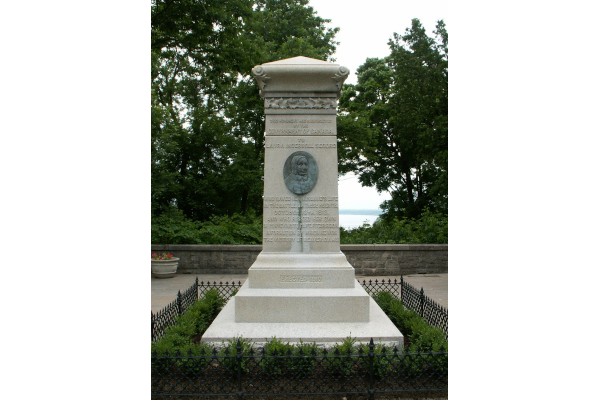
Queenston, Ontario, Canada
A 7-foot granite monument commemorating Laura Secord’s bravery and heroism in warning the British forces of a planned American attack on Niagara Peninsula stands in Queenston Heights Park since 1910, overlooking the Niagara River.
Early feminist groups and members of the United Empire Loyalist Association initiated the monument’s creation, and the government-funded it. It has a Bas-relief portrait of Secord and an inscription that reads: “To Laura Ingersoll Secord, who saved her husband’s life in the battle on these Heights October 13th, 1812 and who risked her own in conveying to Capt. FitzGibbon information by which he won the victory of Beaverdams.”
Laura Secord (1775-1868) was born in Great Barrington in the colonial Province of Massachusetts Bay. In 1795, she moved with her family and other Loyalist refugees to Queenston in Upper Canada, where she met and married James Secord.
When the War of 1812 broke out between the US and the United Kingdom and its British North America allies, Secord’s husband served in the 1st Lincoln Militia. When she heard he was severely wounded, she rushed to his side and begged for his life from the American soldiers, who presumably were about to beat him to death.
By June 1813, the Americans had occupied Fort George, Queenston, and the Niagara area. On June 21st, 1813, Secord overheard the American plans for a surprise attack of British troops at Beaver Dams. She embarked on a 20 miles walk from Queenston to the British headquarters in Thorold Township to warn Lieutenant James FitzGibbon of the impending attack. Based on her intel, the British and their Mohawk allies were well prepared and defeated the Americans.
Secord’s story did not become famous until the late 1880s, when feminist groups discovered it and made it a pillar of women’s suffrage. Throughout the years, her bravery and devotion have been the subject of books, poetry, and plays, while gaining mythic status in Canada.
A 10-minute walk from the monument stands the Laura Secord Homestead. A museum that tells the story and legacy of Secord in the house she lived during 1803-1835. Read more...

Victoria, British Columbia, Canada
Along the Harbourfront of her home city of Victoria, on the grounds of the Fairmount Empress Hotel, across the street from Royal BC Museum and the First Nation Totem Pole, stands a bronze statue of the iconic Canadian painter and writer Emily Carr, best known for her Modernist and Post-Impressionist paintings of western coast landscape and First Nations villages.
Dedicated on October 13th, 2010, the statue was commissioned by the Parks and Recreation Foundation of Victoria. The Canadian sculptress Barbara Paterson created it. She is famous for her Famous Five Monuments in Ottawa and Calgary. It depicts Carr sitting on a rock, holding a pencil and a sketchpad in one hand and with the other hand reaching to her pet Javanese monkey Woo who sits on her shoulder, while her dog Billie is by her feet. Next to the statue, there is a book-shaped plaque detailing her biography.
Emily Carr (1871-1945) was born in Victoria, British Columbia. She showed artistic tendencies from a young age but started to study art professionally only at 19 after her parents died. Carr attended art schools in San Francisco, London, and Paris and developed a unique style of painting characterized by bold and vibrant colors. On her return to Canada, she traveled to First Nations villages, painting the wild nature of the countryside and the indigenous people and their artifacts. Her recognition grew gradually, but only in 1927, at 56, did Carr exhibit her work at the National Gallery of Canada. Afterward, she held exhibitions in the US and Europe. In her late 60s, after suffering several heart attacks and a severe stroke, Carr stopped painting and turned to writing. She published six autobiographical books before she died at the age of 74.
A two-minute drive or a 10-minute walk south will get you to Carr House. It was Carr’s childhood home and nowadays is a museum dedicated to telling her life story and exhibiting her art. Read more...

